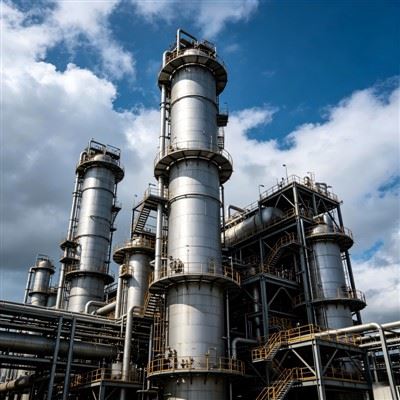
Packed Absorption Tower Guide: How to Select Packing, Bed Size, Internals, Absorbing Liquid and Operating Conditions
A Deep Engineering and Purchasing Guide for Chemical, Petrochemical and Gas Treatment Applications
A packed absorption tower may look deceptively simple.
From the outside, it is usually a vertical cylindrical tower with several nozzles.
Inside, however, a properly designed packed absorption tower is a highly integrated gas-liquid mass-transfer system.
Its performance depends on the interaction between:
Gas flow + liquid flow + packing material + packed-bed height + tower diameter + liquid distribution + gas distribution + pressure drop + operating conditions.
A tower can have an expensive shell and excellent welding quality and still fail to achieve the required absorption efficiency if the packing is incorrectly selected or the liquid distributor does not provide uniform irrigation.
Likewise, increasing the packing height does not automatically solve an absorption problem.
A larger tower diameter does not automatically mean better performance.
Increasing liquid circulation does not always improve removal efficiency.
And choosing the most expensive packing material does not necessarily produce the lowest lifecycle cost.
The real engineering challenge is to create the right relationship between the process chemistry, mass-transfer requirements, hydraulic capacity and equipment construction.
For EPC contractors, process engineers, plant owners and procurement managers, this guide explains how to evaluate a packed absorption tower from five critical perspectives:
Packing Material
Packed Bed Size
Tower Internals
Absorbing Liquid
Operating Conditions
It also explains how an experienced chemical equipment manufacturer such as GYRO can support the transition from process requirements to tower design, fabrication, inspection and project delivery.
1. What Is a Packed Absorption Tower?
A packed absorption tower is a vertical gas-liquid contactor designed to transfer one or more components from a gas stream into a liquid absorbent.
In a typical counter-current configuration:
Gas flows upward.
Liquid flows downward.
The packing provides a large wetted surface where the two phases contact each other.
The target component in the gas phase transfers through the gas-liquid interface and becomes absorbed into the liquid.
A simplified process looks like this:
CLEAN GAS OUT
↑
┌───────────────┐
│ Mist Eliminator │
├───────────────┤
│ Liquid │
│ Distributor │
├───────────────┤
│ │
│ PACKED BED │
│ │
│ │
│ Gas ↑ Liquid ↓ │
│ │
├───────────────┤
│ Packing Support │
├───────────────┤
│ Gas Inlet → │
└───────┬───────┘
↓
Rich Liquid Out
The packing is therefore not simply a filler material.
It is the mass-transfer surface of the tower.
EPA technical guidance describes packed-bed scrubbers in essentially this way: packing creates a large surface area for gas-liquid contact, while the liquid is introduced above the packing and flows downward over the packing surface.
2. The Five Variables That Determine Packed Tower Performance
A good packed absorption tower should be designed as an integrated system.
The five major variables are:
1. Packing Material
Determines surface area, void fraction, pressure drop, wettability, chemical compatibility and hydraulic capacity.
2. Packed Bed Size
Determines the available mass-transfer area and residence/contact conditions.
3. Tower Internals
Determine whether gas and liquid are actually distributed uniformly across the tower cross-section.
4. Absorbing Liquid
Determines the chemical driving force, solubility, reaction behavior, circulation rate and operating cost.
5. Operating Conditions
Determine whether the tower operates efficiently or approaches loading, flooding, excessive pressure drop or poor absorption.
These variables cannot be optimized independently.
Changing one often changes the optimum of the others.
3. The Most Important Insight: A Packed Tower Is a Mass-Transfer System, Not a Steel Vessel
Many buyers begin the purchasing process by asking:
What is the tower diameter?
or:
How much does a packed tower cost?
These are understandable questions, but they come too early.
The first question should be:
What mass-transfer duty must the tower accomplish?
For example:
What contaminant needs to be removed?
What is its inlet concentration?
What is the required outlet concentration?
What is the gas flow rate?
What is the liquid flow rate?
What is the gas temperature?
What is the operating pressure?
What absorbent will be used?
Is the absorption physical or chemical?
Is the process continuous or intermittent?
Only after these questions are understood can the manufacturer determine the appropriate packing, tower diameter and packed-bed height.
4. FIGURE 1 - Packed Absorption Tower Process Flow Diagram
Recommended website diagram:
┌─────────────────┐
│ GAS OUTLET │
│ Treated Gas ↑ │
└────────┬────────┘
│
┌────────▼────────┐
│ Mist Eliminator │
├─────────────────┤
│ Liquid │
│ Distributor │
├─────────────────┤
│
│
│ PACKED BED │
Absorbing Liquid │ │
↓ │ Gas ↑ │
┌──────────────┐ │ Liquid ↓ │
│ Liquid Pump │──►│ │
└──────┬───────┘ ├─────────────────┤
│ │ Packing Support │
│ └────────┬────────┘
│ │
│ │
│ Gas Inlet →
└───────────────┐ │
│ │
▼ ▼
Rich Liquid Outlet
Suggested graphic style
Use a clean engineering cutaway:
Blue = absorbing liquid
Gray = tower shell
Green = packing
Red = contaminated gas
White/blue arrows = flow direction
This figure should be placed near the beginning of the article because it immediately helps non-specialist procurement buyers understand how the equipment works.
5. Packing Material: The Heart of the Absorption Tower
If the tower shell is the body of the equipment, the packing is its mass-transfer surface.
The packing should provide:
High effective surface area
Adequate void volume
Good liquid wetting
Low pressure drop
Good gas-liquid contact
Chemical compatibility
Mechanical strength
Resistance to fouling
Acceptable cost
EPA guidance notes that packing selection depends on factors including contaminant characteristics, contact arrangement, absorber size and treatment objectives. It also identifies pressure drop and corrosion resistance as important packing-selection considerations.
This means there is no universally "best" packing.
There is only the most appropriate packing for a particular process.
6. Random Packing vs Structured Packing
Two major packing categories are:
Random Packing
Random packing consists of individual packing elements dumped into the tower.
Examples include:
Pall rings
Raschig-type rings
Saddles
Other high-capacity random packing
Advantages can include:
Relatively simple installation
Good hydraulic capacity
Flexible selection of materials
Broad application range
Suitable for many absorption and scrubbing applications
Random packing is often attractive where cost, robustness and general-purpose operation are important.
Structured Packing
Structured packing consists of organized elements arranged in a specific geometry.
Advantages can include:
High effective surface area
Low pressure drop
Good efficiency
Suitable for applications where pressure drop is particularly important
Structured packing can be attractive for:
Vacuum applications
High-efficiency separation
Low-pressure-drop processes
Large-scale gas absorption
However, structured packing can be more sensitive to liquid distribution quality.
This leads to a crucial engineering principle:
The more sophisticated the packing, the more important the quality of the liquid distributor becomes.
7. Packing Size: Bigger Is Not Always Better
Packing size affects several competing factors.
Larger packing generally provides greater void volume and can reduce pressure drop.
Smaller packing can provide greater surface area per unit volume but may increase pressure drop.
EPA documentation explicitly notes this trade-off: larger packing for a given bed can reduce pressure drop, while packing characteristics affect hydraulic resistance and gas-liquid contact.
Therefore, packing selection should consider:
Surface area + void fraction + pressure drop + liquid distribution + fouling + mechanical strength.
The cheapest packing is not necessarily the most economical.
The packing with the highest surface area is not necessarily the best.
8. Chemical Compatibility of Packing
Packing material must be compatible with:
Gas composition
Absorbing liquid
Temperature
Concentration
Pressure
Oxidizing conditions
Corrosive contaminants
Common packing materials can include:
Polypropylene
Polyethylene
PVC
PTFE
Ceramic
Carbon materials
Stainless steel
Other metals or engineered materials
For highly corrosive systems, corrosion resistance may dominate the selection.
For high-temperature applications, temperature resistance may become more important.
For systems containing suspended solids, fouling resistance may become the primary consideration.
9. The Hidden Problem: Packing Fouling
Packing can gradually lose performance because of:
Dust
Solids
Polymer deposits
Salts
Corrosion products
Biological growth
Reaction by-products
Fouling can reduce the effective void space.
This increases:
Pressure drop
Liquid holdup
Gas resistance
and can eventually contribute to flooding.
Therefore, when selecting packing, buyers should ask:
What happens to this packing after six months, one year or three years of actual plant operation?
That is a much more valuable question than simply asking for its initial surface area.
10. Packed Bed Size: How Tall Should the Packing Be?
Packed-bed height is determined by the required mass-transfer performance.
A simplified conceptual relationship is:
Required Packing Height ≈ Number of Transfer Units × Height of a Transfer Unit
The actual calculation depends on:
Gas composition
Liquid composition
Equilibrium relationship
Mass-transfer coefficients
Gas flow
Liquid flow
Packing characteristics
Operating temperature
Operating pressure
Increasing packed-bed height can increase mass-transfer opportunity.
But there is a point of diminishing economic return.
More packing means:
Higher tower cost
More packing cost
Larger tower shell
Greater pressure drop
More structural requirements
Potentially more difficult maintenance
Therefore:
Do not specify packed height simply by copying a similar tower.
It should be determined from the actual absorption duty.
11. Bed Diameter and Bed Height Must Be Designed Together
A common mistake is to treat tower diameter and packing height as separate decisions.
They are strongly interconnected.
Tower diameter determines:
Gas velocity
Liquid loading
Flooding margin
Cross-sectional area
Hydraulic capacity
Packing height determines:
Available mass-transfer area
Required separation performance
Pressure drop
Tower height
A narrow tower may require a lower gas-flow velocity margin.
A very large tower may increase capital cost without providing meaningful additional separation performance.
EPA design procedures use gas and liquid flow conditions, fluid properties and packing characteristics to estimate flooding behavior and column diameter.
12. Flooding: The Condition Every Buyer Should Understand
Flooding is one of the most important hydraulic limits in a packed tower.
As gas velocity increases, the upward gas flow increasingly resists the downward liquid flow.
Eventually, liquid begins accumulating within the packed bed.
Pressure drop rises sharply.
Liquid may be carried upward with the gas.
Mass transfer becomes unstable.
This is flooding.
EPA packed-tower guidance describes flooding as a condition where liquid accumulates in the packing and blocks gas flow, increasing pressure drop and reducing effective gas-liquid contact.
Therefore, the tower should not normally be designed to operate at the flooding point.
A practical design requires an appropriate operating margin below flooding.
13. FIGURE 2 - Packed Tower Hydraulic Operating Window
Recommended engineering diagram:
Pressure Drop
↑
│ FLOODING
│ /
│ /
│ __/
│ __/
│ __/
│ __/
│ __/
│ __/
│ __/
│______/____________________________ → Gas Velocity
↑ Normal Operating Zone
The graphic should show:
Low gas velocity
Loading region
Normal operating zone
Rapid pressure-drop increase
Flooding point
This is one of the most valuable diagrams for the article because it explains why "making the tower smaller to save money" can create a serious operating problem.
14. Liquid Distribution: The Most Underrated Part of the Tower
A high-quality packing material cannot compensate for poor liquid distribution.
If the absorbing liquid enters the packed bed through only a few locations, the liquid will preferentially flow through certain paths.
Other sections of the packing may remain poorly wetted.
This creates:
Liquid channeling → reduced effective area → lower mass transfer → poor removal efficiency.
EPA guidance specifically warns that liquid introduced at only one point can channel through the packing rather than wetting the full tower cross-section.
Therefore:
A good packing system begins with a good liquid distributor.
15. Liquid Distributor Design
A liquid distributor may use:
Trough distributors
Pipe distributors
Orifice distributors
Spray-type distributors
Other project-specific designs
The selection depends on:
Tower diameter
Liquid flow rate
Liquid viscosity
Packing type
Required distribution quality
Fouling tendency
Maintenance requirements
The distributor should provide sufficiently uniform irrigation across the packed bed.
A small manufacturing error in the distributor can have a disproportionately large effect on tower performance.
16. FIGURE 3 - Liquid Distribution and Channeling
Recommended website illustration:
GOOD DISTRIBUTION
┌─────────────────────┐
│ ↓ ↓ ↓ ↓ ↓ ↓ ↓ ↓ ↓ │
│ ─────────────────────│
│ ↓ ↓ ↓ ↓ ↓ ↓ ↓ ↓ ↓ │
│ PACKED BED │
│ ↓ ↓ ↓ ↓ ↓ ↓ ↓ ↓ ↓ │ │ ↓ ↓ ↓ ↓ ↓ ↓ ↓ ↓ ↓ │
└─────────────────────┘
POOR DISTRIBUTION
┌─────────────────────┐
│ ↓ │
│ ↓ │
│ ↓↓ │
│ ↓↓↓ │
│ PACKED BED │
│ ↓↓↓ │
│ ↓↓↓ │
└─────────────────────┘
CHANNELING
Use a split-screen engineering illustration.
Left:
Uniform Irrigation
Right:
Liquid Channeling
This figure can become one of the strongest visual assets on the page.
17. Liquid Redistributors Become Important in Tall Packed Beds
As liquid flows downward through the packing, it can gradually migrate toward the tower wall.
This can create maldistribution in tall packed beds.
For sufficiently high packing sections, liquid redistributors may be required.
The function is to:
Collect liquid
Re-mix it
Re-distribute it
Restore uniform irrigation
This is one reason a very tall packed bed should not always be treated as a single uninterrupted packing section.
18. Packing Support Is a Mechanical Component, Not Just a Grid
The packing support must:
Carry the packing weight
Allow gas flow
Allow liquid drainage
Resist corrosion
Maintain mechanical stability
It must also be compatible with the selected packing.
The support design should account for:
Packing density
Liquid holdup
Tower diameter
Operating conditions
Maintenance loading
Installation requirements
A weak or poorly designed support system can lead to packing collapse.
19. Packing Hold-Down Device
The packing may need a hold-down grid or retaining system.
Its purpose is to prevent packing movement caused by:
Gas velocity
Pressure fluctuations
Start-up and shutdown
Vibration
Surging
This becomes particularly important for lightweight plastic packing.
The hold-down system should restrain the packing without creating excessive pressure drop.
20. Mist Eliminator: The Final Protection Before Gas Exit
At the top of the tower, liquid droplets can be entrained in the gas stream.
A mist eliminator helps capture these droplets.
Without adequate mist elimination, the tower may experience:
Liquid carryover
Downstream corrosion
Contamination
Product loss
Environmental problems
Fouling of downstream equipment
Possible mist-eliminator technologies include:
Wire mesh demisters
Vane-type mist eliminators
High-efficiency droplet separators
The appropriate type depends on:
Droplet size
Gas velocity
Liquid properties
Pressure drop
Fouling tendency
21. Gas Inlet Distribution Matters Too
Most discussions focus on liquid distribution.
But gas distribution is also important.
If gas enters the packed bed unevenly, some areas may receive excessive gas flow while others receive insufficient gas flow.
This can cause:
Local flooding
Poor mass transfer
Channeling
Uneven pressure drop
Therefore, the gas inlet should be designed to reduce excessive momentum and distribute gas appropriately across the tower cross-section.
22. The Absorbing Liquid: Chemistry Determines Performance
The absorbing liquid is not simply "water."
Depending on the contaminant, the process may use:
Water
Caustic solution
Acid solution
Amine solution
Oxidizing solution
Organic solvent
Proprietary absorbent
Other chemical solutions
The absorbent should be selected according to the chemistry of the target component.
Important questions include:
Is the contaminant physically soluble?
Does a chemical reaction occur?
Is the reaction fast enough?
Is the absorbent regenerated?
Is the absorbent consumed?
Does the absorbent corrode the tower?
Does the absorbent generate solids?
23. Physical Absorption vs Chemical Absorption
This distinction is fundamental.
Physical Absorption
The contaminant dissolves in the liquid.
Performance is strongly influenced by:
Solubility
Temperature
Pressure
Gas-liquid contact
Chemical Absorption
The contaminant reacts with the absorbing liquid.
The chemical reaction can significantly increase the driving force for removal.
However, it can also create:
Heat generation
Chemical consumption
By-products
Corrosion
Regeneration requirements
The tower design should therefore be developed together with the absorption chemistry.
24. Liquid-to-Gas Ratio: One of the Most Important Operating Variables
The relationship between liquid flow and gas flow strongly affects tower performance.
Too little liquid:
Packing may not be adequately wetted
Mass-transfer area decreases
Removal efficiency can fall
Too much liquid:
Pumping cost increases
Liquid holdup increases
Pressure drop may increase
Flooding margin decreases
EPA guidance emphasizes that packed towers have lower and upper liquid/gas operating limits and require sufficient liquid to wet the packing while avoiding flooding.
Therefore:
More liquid does not automatically mean better absorption.
The objective is an optimized operating window.
25. Gas Temperature Can Change Absorption Performance
Gas temperature affects absorption.
In many applications, higher temperature reduces absorption capacity.
It may also increase absorbent evaporation or solvent loss.
EPA guidance notes that higher gas temperature can reduce absorption rate and that precooling may sometimes be necessary before absorption.
Therefore, if a hot gas stream enters the tower, the process engineer should ask:
Should the gas be cooled before absorption?
A simple upstream cooler can sometimes improve the overall economics of the absorption system.
This also creates opportunities for integrating:
[GYRO PRODUCT: Heat Exchanger]
into the gas-treatment process.
26. Tower Operating Pressure Matters
Pressure can influence:
Gas density
Solubility
Mass transfer
Gas velocity
Tower diameter
Absorption equilibrium
For high-pressure applications, mechanical design becomes increasingly important.
For vacuum or near-vacuum applications, pressure drop becomes particularly important.
This is because every additional pressure loss may directly affect the process.
Therefore, the same packing that is acceptable at atmospheric pressure may not be optimal for a low-pressure process.
27. Pressure Drop: The Cost You Pay Every Hour
Pressure drop is not just a design number.
It has an operating cost.
For gas-treatment systems using fans or blowers, pressure drop translates into energy consumption.
EPA notes that pressure drop in packed towers depends on gas and liquid flow rates and packing characteristics, and higher pressure drop requires greater fan power.
This leads to a useful purchasing principle:
Do not optimize only for the lowest equipment price. Optimize for total operating cost.
A slightly more expensive packing system may be economically superior if it reduces pressure drop year after year.
28. The Relationship Between Tower Diameter and Energy Cost
Tower diameter has an interesting economic relationship with pressure drop.
A larger tower:
Reduces gas velocity
Increases cross-sectional area
Can reduce pressure drop
Increases equipment cost
A smaller tower:
Reduces shell cost
Increases gas velocity
Can increase pressure drop
Reduces flooding margin
Therefore, the optimum diameter is an economic and hydraulic compromise.
The cheapest tower is not necessarily the cheapest system.
29. Why "More Packing" Is Not Always the Solution
Suppose an existing tower does not achieve the required removal efficiency.
The first instinct may be:
Add more packing.
But this may not solve the actual problem.
The real cause could be:
Poor liquid distribution
Incorrect absorbent concentration
Insufficient liquid circulation
Excessive gas flow
High gas temperature
Channeling
Flooding
Wrong packing type
Fouled packing
Poor gas distribution
Adding more packing to a tower with poor hydraulic distribution may simply add more expensive equipment without solving the fundamental problem.
This is why troubleshooting should begin with the entire system.
30. Common Packed Tower Failure Modes
Failure 1 - Low Removal Efficiency
Possible causes:
Insufficient packing height
Poor liquid distribution
Insufficient liquid flow
Incorrect absorbent
High gas temperature
Excessive gas velocity
Failure 2 - Excessive Pressure Drop
Possible causes:
Excessive gas velocity
Flooding
Fouled packing
Packing size too small
Excessive liquid loading
Failure 3 - Liquid Carryover
Possible causes:
Excessive gas velocity
Flooding
Poor mist eliminator
Excessive liquid loading
Failure 4 - Corrosion
Possible causes:
Incorrect tower material
Incorrect absorbent chemistry
Chloride contamination
Incorrect operating temperature
Poor material compatibility
Failure 5 - Packing Collapse
Possible causes:
Poor support design
Excessive mechanical load
Poor installation
Excessive gas velocity
Inadequate hold-down system
31. Material Selection for the Tower Shell
The tower shell should be selected based on:
Gas composition
Liquid composition
Temperature
Pressure
Chloride concentration
Acid concentration
Solvent properties
Corrosion rate
Design life
Possible construction materials include:
Carbon steel
Stainless steel
Duplex stainless steel
Nickel alloys
Lined carbon steel
Other corrosion-resistant materials
Material selection is particularly important because packed absorption towers can expose the shell to both gas-phase and liquid-phase corrosion.
32. Why Fabrication Quality Matters in a Packed Tower
A packed tower is still a pressure-containing industrial vessel.
Its fabrication involves:
Shell rolling
Longitudinal welding
Circumferential welding
Nozzle fabrication
Internal support welding
Platforms
Manholes
Flanges
Lifting lugs
Internal installation
Poor fabrication can lead to:
Nozzle misalignment
Internal installation problems
Leakage
Structural deformation
Difficult field piping alignment
Therefore, engineering design and fabrication should be treated as one integrated process.
33. GYRO's Capability for Customized Chemical Towers
GYRO's product portfolio includes:
The company specializes in chemical and petrochemical equipment engineering, fabrication, installation, modification, maintenance and technical services.
Its manufacturing operations date back to 2002, while its design company was established in 2016.
GYRO's manufacturing facility covers approximately:
30,000 m² total facility area
20,000 m² workshop area
The company reports:
50+ design professionals
68 manufacturing personnel
15 engineering and technical personnel
8,000+ tons annual designed production capacity
150+ manufacturing and processing equipment units
GYRO also has:
14 certified welders
36 qualified welding items
4 qualified NDT personnel
13 RT, UT, MT and PT inspection items
The company holds an A2-level Pressure Vessel Design and Manufacturing License.
For a customized packed absorption tower, these capabilities are important because the equipment involves both sophisticated internal structures and pressure-boundary fabrication.
34. GYRO Can Integrate Packed Tower Manufacturing with Other Process Equipment
A packed absorption tower rarely works alone.
A complete process system may include:
Gas Pre-Cooler → Packed Absorption Tower → Mist Eliminator → Fan/Blower → Stack
The liquid system may include:
Tower Bottom → Circulation Pump → Heat Exchanger → Chemical Addition → Liquid Distributor → Tower
GYRO's broader equipment portfolio includes:
[GYRO PRODUCT: Heat Exchanger]
[GYRO PRODUCT: Chemical Reactor]
[GYRO PRODUCT: Stainless Steel Reactor]
[GYRO PRODUCT: Glass Lined Reactor]
[GYRO PRODUCT: Fired Heater]
[GYRO PRODUCT: Chemical Tower]
This makes it possible to consider the tower as part of a larger process-equipment package.
35. FIGURE 4 - Complete Packed Absorption System
Recommended website process diagram:
CONTAMINATED GAS
│
▼
┌────────────────┐
│ Gas Pre-Cooler │
└───────┬────────┘
│
▼
┌──────────────────────┐
│ PACKED ABSORPTION │
│ TOWER │
│ Gas ↑ Liquid ↓ │
│ │
│ Packed Bed │
│ │
│ │
└───────┬──────────────┘
│
Treated Gas
│
▼
┌────────────────┐
│ Mist Eliminator │
└───────┬────────┘
│
▼
CLEAN GAS
Tower Bottom Liquid
│
▼
┌─────────────┐
│ Circulation │
│ Pump │
└──────┬──────┘
│
▼
┌─────────────┐
│ Chemical │
│ Addition │
└──────┬──────┘
│
▼
Liquid Distributor
│
└──────► Tower
This figure is particularly suitable for a B2B buyer audience, because it shifts the page from "we manufacture a tower" to "we understand the complete absorption system."
36. What Should You Tell a Packed Tower Manufacturer?
For an accurate technical proposal, provide:
Gas Data
Gas flow rate
Gas composition
Contaminant concentration
Gas temperature
Gas pressure
Moisture content
Dust/solids content
Liquid Data
Absorbent type
Concentration
Liquid flow rate
Temperature
Density
Viscosity
pH
Corrosiveness
Performance Requirements
Inlet concentration
Required outlet concentration
Removal efficiency
Maximum allowable pressure drop
Operating hours
Design life
Mechanical Requirements
Design pressure
Design temperature
Material requirement
Corrosion allowance
Tower diameter limitations
Tower height limitations
Applicable design code
Internal Requirements
Packing type
Packing material
Packing height
Liquid distributor
Redistributor
Packing support
Packing hold-down
Mist eliminator
Gas inlet distributor
If the customer does not know the packing or internal configuration, that is not necessarily a problem.
A capable manufacturer should be able to help determine the configuration from the process data.
37. How to Evaluate a Packed Tower Quotation
Do not compare suppliers only using:
Total Price
Instead, create a technical comparison table.
| Parameter | Supplier A | Supplier B | Supplier C |
|---|---|---|---|
| Tower Diameter | |||
| Tower Height | |||
| Packed Height | |||
| Packing Type | |||
| Packing Material | |||
| Packing Specific Area | |||
| Void Fraction | |||
| Liquid Distributor | |||
| Redistributor | |||
| Mist Eliminator | |||
| Design Pressure | |||
| Design Temperature | |||
| Material | |||
| Corrosion Allowance | |||
| Design Pressure Drop | |||
| Gas Velocity | |||
| Flooding Margin | |||
| NDT | |||
| Inspection | |||
| Documentation | |||
| Delivery Time |
This approach often reveals that apparently cheaper quotations are based on very different technical assumptions.
38. A Better Way to Compare Packing Materials
When evaluating packing quotations, ask for:
Packing type
Material
Nominal size
Specific surface area
Void fraction
Packing factor
Bulk density
Operating temperature limit
Chemical compatibility
Pressure-drop data
Flooding data
Manufacturer technical data
Do not compare packing only by:
Price per cubic meter.
The correct comparison is:
Mass-transfer performance + hydraulic performance + chemical compatibility + service life + lifecycle cost.
39. How GYRO Approaches Custom Packed Tower Manufacturing
For GYRO, the equipment manufacturing process can begin with:
Process Data
↓
Technical Clarification
↓
Process / Mechanical Design
↓
Tower & Internal Design
↓
Material Selection
↓
Fabrication
↓
Welding
↓
NDT
↓
Dimensional Inspection
↓
Internal Assembly
↓
Pressure / Leak Testing
↓
Final Inspection
↓
Transportation
↓
Installation Support
This approach is particularly useful for EPC contractors that need equipment manufactured according to project-specific drawings and specifications.
40. FIGURE 5 - GYRO Packed Tower Manufacturing Workflow
Recommended visual style:
PROCESS DATA │ ▼ TECHNICAL REVIEW │ ▼ PROCESS + MECHANICAL DESIGN │ ▼ PACKING & INTERNAL SELECTION │ ▼ MATERIAL PROCUREMENT │ ▼ SHELL FABRICATION │ ▼ INTERNAL FABRICATION │ ▼ WELDING + NDT │ ▼ DIMENSIONAL INSPECTION │ ▼ INTERNAL ASSEMBLY │ ▼ TESTING │ ▼ FINAL INSPECTION │ ▼ DELIVERY + INSTALLATION SUPPORT
This diagram can be branded with GYRO and used not only in this article but also on the future Chemical Tower product page.
41. The Difference Between a Tower Fabricator and a Process Equipment Manufacturer
This distinction matters.
A basic fabricator may be able to produce:
Cylindrical shells
Flanges
Nozzles
Platforms
But a process equipment manufacturer should understand how:
Packing + distributor + liquid + gas + pressure drop + mass transfer + fabrication
interact.
For a packed absorption tower, this difference is particularly important.
The shell may be mechanically perfect.
But if the liquid distributor is poorly designed, the tower may still underperform.
The packing may be excellent.
But if the gas inlet creates maldistribution, performance can still suffer.
The tower may have sufficient height.
But if the operating liquid rate is too low, the packing may not be effectively wetted.
This is why engineering capability matters.
42. Why GYRO's A2 Pressure Vessel Capability Matters
A packed absorption tower is often a large customized pressure-containing structure.
GYRO's A2-level Pressure Vessel Design and Manufacturing License provides an important foundation for pressure-equipment projects.
Combined with:
Engineering personnel
Certified welders
NDT capability
Manufacturing workshop
Heavy fabrication equipment
Quality-control procedures
this allows the tower to be approached as engineered pressure equipment rather than simply fabricated steel.
For customers, that distinction can reduce project coordination risk.
43. The Most Common Procurement Mistakes
Mistake 1: Selecting Packing Before Defining the Process
Packing selection should follow process requirements.
Mistake 2: Specifying Tower Height Without Mass-Transfer Calculation
A taller tower is not automatically a better absorber.
Mistake 3: Ignoring Liquid Distribution
Poor distribution can destroy the theoretical performance of high-quality packing.
Mistake 4: Designing Too Close to Flooding
A tower should have an appropriate hydraulic operating margin.
Mistake 5: Ignoring Pressure Drop
Pressure drop becomes operating energy cost.
Mistake 6: Selecting Materials Only by Initial Price
Corrosion can dominate lifecycle cost.
Mistake 7: Ignoring Fouling
The tower must be designed for actual plant conditions.
Mistake 8: Treating the Tower as a Standalone Equipment Item
The gas pre-cooler, pump, heat exchanger, chemical dosing system and downstream equipment can affect overall performance.
44. The Most Important Insight: Design the Tower Around the Process
There is no universal packed absorption tower.
There is no universal packing.
There is no universal liquid flow rate.
There is no universal packed-bed height.
The correct design depends on the interaction between:
Contaminant + Gas + Absorbent + Packing + Hydraulics + Mass Transfer + Operating Conditions.
This is why process data should come before equipment dimensions.
45. When Should You Choose a Customized Packed Absorption Tower?
Customized design is particularly valuable when:
Gas flow is large
Contaminant concentration is high
Removal efficiency requirements are strict
Gas is corrosive
Absorbent is corrosive
Pressure drop is limited
Space is restricted
Existing equipment must be replaced
Special packing is required
Multiple packed beds are required
Heat integration is required
The tower is part of a large EPC project
In these situations, a standard catalog absorber may not provide the best technical or economic solution.