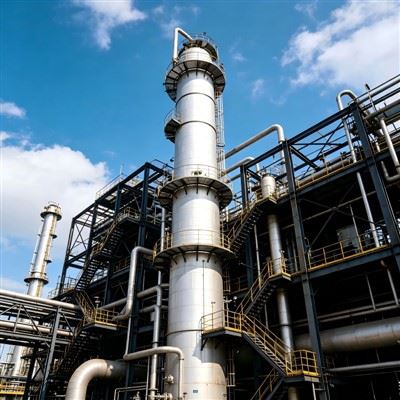

Difference Between an Absorption Tower and a Standard Scrubber
|
Item |
Absorption Tower |
General Scrubber |
|
Main Purpose |
Gas absorption and mass transfer |
Gas cleaning / pollutant removal |
|
Design Focus |
Mass transfer efficiency |
Washing and contaminant removal |
|
Key Parameters |
L/G ratio, packing, HTU/NTU, pressure drop |
Spray rate, droplet removal, pressure drop |
|
Typical Media |
HCl, SO₂, NH₃, H₂S, CO₂ |
Acid mist, dust, soluble gases |
|
Design Complexity |
Higher for demanding separation duties |
Relatively simpler |
|
Typical Configuration |
Packed / Tray / Multi-stage Tower |
Spray / Packed Scrubber |
Manufacturing Process
Basic Workflow:
Process Data → Absorption Calculation → Tower Sizing → Internals Design → Material Selection → Mechanical Design → Fabrication → Inspection → Delivery
Key Control Points During Manufacturing:
Shell dimensions
Tower verticality
Weld quality
Nozzle positioning
Installation dimensions of internals
Flange parallelism
Packing support structure
For large-scale towers, factors such as on-site lifting, sectional transport, and installation conditions are considered in advance.

Customized Solutions and EPC Projects

If you already possess existing P&IDs, equipment data sheets, or preliminary drawings, we can proceed with detailed engineering based on your project documentation.
Alternatively, if the project is still in the conceptual phase, we can handle the design process starting from the initial process parameters.
We offer a range of solutions, including individual absorption towers, packed absorption towers, multi-stage absorption systems, absorption and demisting systems, as well as integrated setups such as tower-plus-circulation-tank, tower-plus-pump-and-piping, and tower-plus-dosing-system configurations.
We also provide complete EPC projects for waste gas treatment.
For large-scale projects, we offer comprehensive support ranging from tower design through to on-site installation and commissioning.
After-Sales and Technical Support
If an issue is confirmed to stem from manufacturing quality, we will handle the matter in accordance with the contract and warranty terms, providing repair, replacement, or on-site technical solutions.
For projects requiring expanded production capacity, increased throughput, or stricter emission standards after a period of operation, we can also re-evaluate the process design and upgrade or modify the existing tower structure.
Packaging and Shipping
Small-scale towers can be manufactured as single units and shipped intact.
For equipment with large diameters or significant heights, sectional manufacturing and on-site assembly can be employed to minimize costs and transport restrictions associated with oversized cargo.
Internal components-such as packing, nozzles, mist eliminators, and liquid distributors-are individually packaged and labeled, then installed on-site in accordance with the assembly list.
Documentation provided prior to shipment includes packing lists, material certificates, inspection reports, welding records, dimensional inspection records, and assembly drawings, enabling on-site personnel to proceed directly with assembly upon receipt of the equipment.
FAQ
Q: What gases can the absorption tower handle?
A: Common examples include HCl, SO₂, NH₃, H₂S, Cl₂, HF, and CO₂. Suitability depends on factors such as gas concentration, temperature, pressure, and the specific absorbent used.
Q: Does a taller absorption tower guarantee better treatment performance?
A: Not necessarily. Absorption performance depends on a combination of factors, including gas-liquid distribution, packing type, liquid-to-gas ratio, mass transfer area, and gas residence time. Blindly increasing the tower height may simply raise investment costs without yielding a proportional improvement in treatment efficiency.
Q: Can the tower body be made of stainless steel?
A: Yes. For high-temperature or highly corrosive media, materials such as SS304, SS316L, duplex steel, or other alloys can be selected based on corrosion rates; for certain corrosive gases at ambient temperatures, non-metallic materials like PP or FRP may also be used.
Q: Can it handle high-temperature gases?
A: Yes, though the inlet temperature usually determines whether additional measures-such as pre-cooling sections, quenching sections, or other temperature control systems-are required. The absorption temperature directly affects the solubility and absorption efficiency of certain gases.
If you already know the exhaust gas composition and treatment capacity, there is no need to purchase equipment before verifying performance.
Simply provide us with details such as the gas name, flow rate, inlet concentration, temperature, pressure, and required outlet concentration. We can then perform absorption calculations to determine the tower diameter, packing height, circulation rate, and material selection, and-depending on project requirements-offer solutions ranging from the fabrication of a single tower to complete systems or full EPC (Engineering, Procurement, and Construction) projects.
Hot Tags: absorption tower, China absorption tower manufacturers, suppliers, factory, Absorption Tower, chemical tower, Methanol Recovery Column, Scrubber Tower