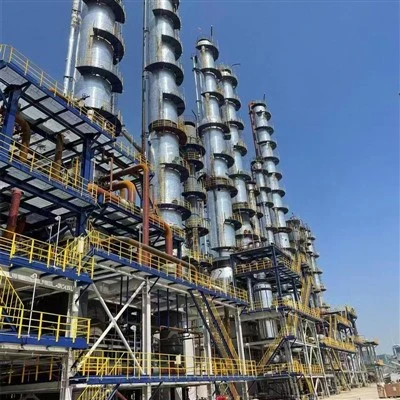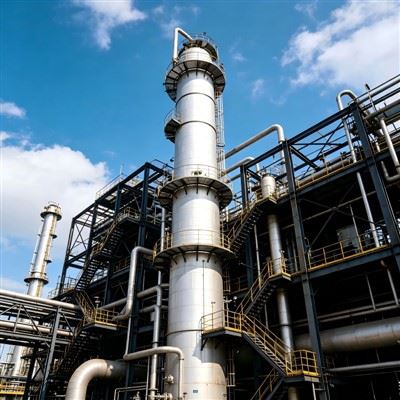


Process Technology
GYRO can design dehydration towers using TEG/DEG liquid absorption, molecular sieve adsorption, or other process routes tailored to your project requirements.
The water-laden "rich glycol" enters the regeneration system, where the absorbed water is removed via heating before the glycol is returned to the top of the tower for recirculation.
For projects requiring lower water content, adsorption solutions-such as molecular sieves-can be employed.
Dehydration Tower Features
Outlet water content can achieve ≤5 lb H₂O/MMscf
If your pipeline or downstream processes require control over natural gas water content, GYRO can reverse-engineer the tower diameter, height, number of trays/packing elements, and glycol circulation rate based on your target specifications.
Significant reduction in dew point
If your project requires control over the water dew point of the gas stream, this dehydration tower does far more than simply reduce water content slightly; it ensures the gas meets the requirements for downstream transportation or processing.

Issues Addressed by the Dehydration Tower
Downstream equipment sensitive to moisture
Excessive moisture can adversely affect cryogenic separation, compression, pipeline transport, and downstream chemical processes.
Dehydration controls outlet moisture content to meet project specifications, mitigating the risk of moisture entering downstream systems.
Natural gas failing to meet sales-gas standards
Designs can be tailored to your specific moisture content or dew point requirements.
Insufficient processing capacity of existing dehydration towers
We can recalculate tower diameter, height, circulation rates, and internals to accommodate capacity expansions or retrofits of existing units.
Excessive equipment pressure drop
Redesigning the tower diameter and internal structure prevents gas velocities from remaining consistently high in the pursuit of higher throughput.
How Is It Different from Standard Market Products?
|
Standard Market Products |
GYRO Dehydration Tower |
|
Standardized dimensions and configurations |
Designed around your actual process conditions |
|
Equipment size selected mainly by gas flow |
Tower diameter, height and internals calculated from gas flow, pressure and water load |
|
Fixed internal configuration |
Trays, packing or molecular sieve beds selected according to the application |
|
Focuses mainly on water removal |
Balances dehydration performance, pressure drop, circulation rate and operating cost |
|
Limited adaptation to existing plants |
Can be customized for new plants, capacity expansion and unit revamps |
|
Tower supplied as an individual vessel |
Can be integrated with glycol circulation, regeneration, heat exchange and process piping |
|
Installation conditions considered separately |
Transportation, lifting, installation space and nozzle orientation can be incorporated during design |
|
Equipment-focused supply |
Engineering design + fabrication + inspection + technical support |
|
After-sales service mainly focused on equipment maintenance |
Technical support can extend to commissioning, performance analysis, maintenance and system modification |

TEG Dehydration
Suitable for the continuous dehydration of large volumes of natural gas and hydrocarbon gases; operates via an absorption-regeneration cycle.
Typical TEG regeneration temperature is approximately 193–204°C (380–400°F).
Molecular Sieve Dehydration
Molecular sieve adsorption is used when projects require very low residual water content.
This method operates through an Adsorption → Regeneration → Cooling → Switching cycle and is suitable for gas processing applications requiring strict moisture control.
If you already have the project parameters, there is no need to determine the equipment model beforehand.
Simply provide the gas flow rate, inlet water content, operating pressure, temperature, and target outlet water content.
Based on this information, GYRO can proceed to determine the dehydration process, column diameter and height, internals, circulation rate, regeneration system, equipment configuration, and project quotation.
For EPC projects, you may also directly provide the PFD, P&ID, or equipment datasheet for technical evaluation by our engineering team.
Hot Tags: dehydration tower, China dehydration tower manufacturers, suppliers, factory, Absorption Tower, chemical tower, Methanol Recovery Column, Scrubber Tower