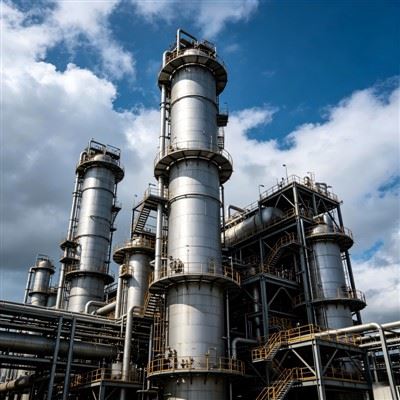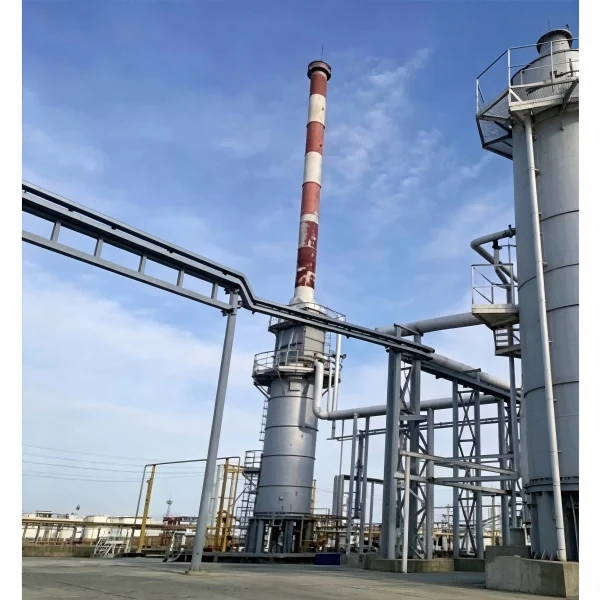


What Key Issues Does The Equipment Address
The Methanol Recovery Column primarily helps plants resolve issues related to methanol feedstock loss, waste liquid disposal costs, solvent procurement expenses, pressure regarding downstream environmental compliance, and fluctuations in methanol concentration during production.
For plants with high methanol consumption, even recovering just a few dozen kilograms per hour translates into significant actual costs when accumulated over the long term.
Product Advantages
For methanol-water systems suitable for rectification recovery, proper design allows the purity of the recovered methanol to reach levels ranging from 90% to over 99.9%, depending on project requirements.
If the recovered methanol is to be reintroduced into the production line, we tailor the separation design to meet the specific end-use specifications.
We adjust parameters such as the number of trays, packing height, column diameter, reflux method, feed location, reboiler type, and condenser configuration based on the characteristics of the feed.
A significant portion of the operating costs for a methanol recovery column stems from the reboiler.
Poor design can lead to high steam consumption per ton of recovered methanol, even if the recovery rate itself is satisfactory. We optimize the system by simultaneously considering reboiler duty, reflux ratio, feed conditions, and heat recovery.
For large-scale projects, we can also implement heat integration by utilizing existing heat sources.
Main Applications of the Methanol Recovery Column
|
Application |
Methanol Recovery Solution |
|
Chemical Production |
Recover methanol from process streams and reduce raw material loss |
|
Pharmaceutical Production |
Recover solvent from methanol-containing process liquids |
|
Fine Chemical Industry |
Separate and reuse methanol from mixed solvents |
|
Resin & Polymer Production |
Recover methanol from reaction-related liquid streams |
|
Biodiesel Production |
Recover methanol from methanol-rich process mixtures |
|
Solvent Recycling |
Recover reusable methanol from waste solvent streams |
|
Wastewater Treatment |
Reduce methanol concentration before downstream treatment |
Technical Specifications
|
Parameter |
Typical Range |
|
Column Type |
Methanol Recovery / Distillation Column |
|
Column Diameter |
DN600–DN4000 mm |
|
Column Height |
8–40 m |
|
Processing Capacity |
0.5–50 t/h |
|
Methanol Feed Concentration |
5–80 wt.% |
|
Methanol Recovery |
Up to 90–99%+* |
|
Product Purity |
90–99.9%+* |
|
Operating Pressure |
Vacuum–0.5 MPa |
|
Design Temperature |
-20°C to 180°C |
|
Tray Type |
Sieve Tray / Valve Tray / Packed Section |
|
Packing Type |
Structured Packing / Random Packing |
|
Column Material |
Carbon Steel / SS304 / SS316L / Duplex / Customized Alloy |
|
Reboiler Type |
Kettle / Thermosiphon / Forced Circulation |
|
Condenser Type |
Shell & Tube / Plate Heat Exchanger |
|
Design Standard |
ASME VIII Div.1 / GB150 / TEMA / Customer Specification |
Manufacturing Process for Methanol Recovery Column
Material Inspection→Plate Cutting & Forming→Shell Rolling→Longitudinal / Circumferential Welding→Fabrication of Internal Components→Installation of Trays / Packing Supports→NDT Inspection→Dimensional Inspection→Hydrostatic / Leak Test→Surface Treatment→Final Inspection & Delivery
For high-pressure equipment, non-destructive testing (NDT)-such as RT, UT, MT, and PT-can be performed in accordance with project requirements.
If you only need to replace a single tower, GYRO can supply the individual unit.
For new methanol recovery projects, we can provide a comprehensive package of auxiliary equipment, including:
● Methanol Recovery Column
● Reboiler
● Condenser
● Reflux Drum
● Feed Preheater
● Reflux Pump
● Product Storage Tank
● Piping System
● Control Instruments
● PLC/DCS Control System
For complete projects, ZIBO GYRO can handle process design, equipment manufacturing, on-site installation, and EPC project execution.

Customization Options for Methanol Recovery Columns
GYRO can tailor the design to your specific process requirements:
- Column Diameter: Calculated based on gas load and allowable gas velocity to prevent flooding.
- Column Height: Determined by target separation efficiency and the number of theoretical stages, rather than a fixed height.
- Feed Location: Determined by feed state and composition to minimize unnecessary reboiler and reflux loads.
- Column Internals: Trays or packing selected based on throughput and mass transfer requirements.
- Materials of Construction: Carbon steel, stainless steel, or special alloys selected based on methanol concentration, temperature, and corrosive impurities.
- Reboiler and Condenser: Individually sized based on thermal load to avoid oversizing the heat transfer area.
Service and Technical Support
- Feed flow rate
- Methanol concentration
- Product purity
- Recovery target
- Operating pressure
- Available steam
- Cooling water conditions
Based on this data, we evaluate and determine the appropriate methanol recovery column solution.
- Design review
- Drawing approval
- Material inspection
- Manufacturing inspection
- Third-party inspection
- Factory Acceptance Test (FAT)
For on-site projects, we provide guidance on equipment and column internal installation, verify piping connections, and assist with system commissioning.
- Failure to meet methanol purity specifications;
- Decreased recovery rate;
- Excessive steam consumption;
- Abnormal overhead temperature;
- or Increased pressure drop;
-we can analyze actual operating data to diagnose the cause and assist you in adjusting operating parameters or evaluating equipment modification plans.
If the issue is confirmed to be a manufacturing quality defect, repairs, replacements, and technical support will be handled in accordance with the warranty terms of the contract.
Packaging and Shipping
Small to medium-sized methanol recovery columns can be manufactured as a single unit and shipped intact.
Large-scale columns are manufactured in sections and assembled on-site to minimize the costs and constraints associated with oversized cargo transport.
Pre-shipment preparations:
- Protective covers installed on flange sealing surfaces;
- Nozzles sealed against dust;
- Column internals individually numbered and packaged;
- Small accessories packed in wooden crates;
- Large equipment secured with steel framing;
- Anti-corrosion protection applied to external surfaces.
For export projects, the following documentation is available:
Packing List / Material Certificate / Inspection Report / Manufacturing Records / Installation Drawings
Why is a Methanol Recovery Column a Worthwhile Investment
Methanol represents a production cost.
If a plant consumes large quantities of methanol and experiences steady losses during production, a recovery system performs a straightforward function:
It converts methanol that would otherwise end up in waste streams back into a usable product.
For instance, if a project processes 20 tonnes of methanol-containing material daily, and even if only 20% of the methanol is actually recoverable, there is theoretically a potential to recover approximately 4 tonnes per day.
Determining whether the investment is worthwhile should not be based on intuition; instead, the actual return on investment should be calculated using the following formula:
(Methanol loss quantity × Methanol procurement cost) − (Steam/cooling water/electricity/maintenance costs)
FAQ
Q: Can the methanol recovery column handle a mixture of methanol and water?
A: Yes, this is a typical application. However, if other components such as ethanol, acetone, or high-boiling substances are present, vapor-liquid equilibrium and separation calculations must be re-evaluated.
Q: What is the maximum achievable methanol recovery purity?
A: There is no single fixed figure. Achievable product purity depends on the specific feed composition and can be adjusted by varying the number of theoretical stages, the reflux ratio, and the operating pressure. While some projects can achieve purities exceeding 99.9%, this must be verified based on the actual feed.
Q: Is vacuum methanol recovery possible?
A: Yes. Vacuum distillation can be employed for processes involving heat-sensitive materials or when a lower reboiler temperature is desired; however, factors such as the vacuum system, condensation temperature, and mechanical equipment design must be taken into account.
Q: Is it possible to purchase just the column without the entire system?
A: Yes. We can manufacture individual columns, or-depending on project requirements-supply reboilers, condensers, reflux drums, pumps, instrumentation, and complete EPC solutions.
If you are interested in our products, please provide GYRO with details regarding feed rate, methanol concentration, target recovery rate, product purity, and existing steam conditions. We can then begin with process calculations to evaluate the methanol recovery column dimensions, internals, reboiler, and condensation system, and provide a comprehensive solution ranging from equipment manufacturing and installation to full EPC contracting.
Hot Tags: methanol recovery column, China methanol recovery column manufacturers, suppliers, factory, Absorption Tower, chemical tower, Methanol Recovery Column, Scrubber Tower