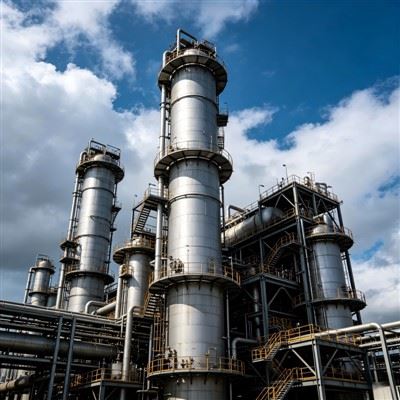
Extraction Column Design and Manufacturing Guide: Process Engineering, Equipment Selection, and Industrial Applications
1. Introduction: Why an Extraction Column Is More Than a Vertical Vessel
When a chemical process requires the recovery, purification, or separation of a component from a liquid mixture, distillation is not always the most economical or technically suitable option.
Components with similar boiling points, azeotropic behavior, high boiling temperatures, or sensitivity to heat may be difficult or expensive to separate by conventional distillation. In these situations, liquid-liquid extraction can provide an alternative by transferring the target component into a second liquid phase with a more favorable solvent affinity.
An industrial Extraction Column creates controlled contact between two liquid phases, allowing a selected component to transfer from one phase into the other. The two phases are subsequently separated, and the solvent may be recovered or regenerated for reuse.
However, designing an extraction column is not simply a matter of calculating vessel diameter and height.
Actual separation performance depends on the equilibrium relationship between the phases, solvent selectivity, interfacial area, droplet size, phase continuity, residence time, axial mixing, and the ability of the equipment to operate within a stable hydraulic range.
A column can be mechanically sound yet perform poorly if the droplets are too large, the phases do not separate properly, the internal components create excessive resistance, or the selected solvent is unsuitable for the process.
For plant owners, EPC contractors, process engineers, and procurement managers, the objective is to obtain equipment that combines effective mass transfer with reliable phase separation, manageable operating costs, maintainable internals, and a practical manufacturing schedule.
This guide explains the engineering principles behind liquid-liquid extraction, the differences between extraction column configurations, the manufacturing challenges that influence equipment reliability, and the information buyers should prepare before requesting a quotation.
2. What Is an Extraction Column?
An extraction column, also called a liquid-liquid extraction tower or solvent extraction column, is a mass-transfer device used to separate one or more components by contacting two liquid phases that have limited mutual solubility.
One phase contains the feed and the target solute. The other phase is the extracting solvent, which preferentially dissolves the target component.
The two phases are brought into contact to promote mass transfer. After sufficient contact, the phases separate according to their physical properties, and the solute becomes distributed between them.
The resulting streams are commonly described as:
Extract: The solvent-rich phase containing the transferred solute.
Raffinate: The original feed-rich phase remaining after extraction.
These terms describe the process streams, not necessarily which phase is heavier or which stream leaves at the top of the column.
2.1 How liquid-liquid extraction works
In a typical countercurrent extraction column, one liquid enters near the top and the other enters near the bottom. The lighter phase may move upward while the heavier phase moves downward, although the actual arrangement depends on phase density, flow configuration, and equipment design.
The internal components create or maintain a suitable dispersion of one liquid within the other.
As droplets move through the continuous phase, the target solute transfers across the liquid-liquid interface. The solute distribution changes progressively along the column, creating a concentration gradient that drives mass transfer.
At the column outlets, the extract and raffinate are routed to downstream separation, solvent recovery, washing, or regeneration systems as required.
2.2 Why extraction may be preferable to distillation
Liquid-liquid extraction can be attractive when:
Components have similar boiling points.
Azeotropes complicate conventional distillation.
The target component has a favorable affinity for a selective solvent.
The product is sensitive to high temperatures.
The target component is present at a relatively low concentration.
Separation by distillation would require excessive energy or difficult operating conditions.
Extraction is not automatically superior. It introduces solvent handling, phase-separation, and often solvent-recovery requirements. The correct technology must be selected by comparing the complete process economics, safety requirements, and achievable separation.
2.3 Extraction versus absorption
Extraction and absorption are different separation operations.
Liquid-liquid extraction transfers a component between two liquid phases.
Gas absorption transfers a component from a gas phase into a liquid phase.
An extraction column therefore typically requires equipment and internal arrangements suited to liquid-liquid dispersion and phase disengagement, whereas a gas absorption tower is designed around gas-liquid contacting and the corresponding hydraulic behavior.
The distinction is important when defining equipment specifications, searching for suppliers, and evaluating quotations.


3. Industrial Applications of Extraction Columns
Liquid-liquid extraction is used across industries where selective solvent transfer provides a useful separation mechanism.
The exact column type, solvent, materials, and internal configuration depend on the process chemistry and operating conditions.
3.1 Petroleum refining and petrochemical processing
In refining and petrochemical facilities, extraction may be used to separate selected hydrocarbon components or remove undesirable compounds from liquid streams.
Potential applications include:
Aromatics extraction from suitable hydrocarbon streams.
Selective recovery of valuable chemical components.
Solvent deasphalting and related heavy-oil separation operations, where the overall process configuration calls for extraction equipment.
Washing of organic process streams.
Recovery of selected high-value components from mixed liquid streams.
Aromatics extraction is an important example. A selective solvent can be used to separate aromatic components from certain non-aromatic hydrocarbons. The extraction column must create adequate contact between the hydrocarbon feed and solvent while maintaining suitable phase separation and minimizing unwanted hydrocarbon losses.
For refinery and petrochemical projects, the design must account for feed variability, solvent properties, operating temperature, density differences, and downstream solvent recovery.
Engineering insight: A high extraction yield is not the only objective. Solvent circulation, raffinate quality, extract purity, solvent losses, hydraulic capacity, and regeneration energy must be evaluated together.
3.2 Chemical and fine chemical manufacturing
Chemical plants may use extraction columns to recover valuable compounds, remove impurities, or separate components that are difficult to isolate by other methods.
Applications can include:
Organic acid recovery.
Separation of selected organic compounds from aqueous solutions.
Solvent washing and purification.
Recovery of valuable intermediates.
Liquid-phase separation in multi-step synthesis.
Removal of impurities before downstream reaction or purification.
Fine chemical processes may operate at lower throughput than refinery systems but require more demanding product purity, selectivity, or contamination control.
The equipment may therefore need carefully selected construction materials, accessible internal components, efficient drainage, and operating flexibility for different production campaigns.
For these projects, the solvent system and phase-separation behavior are as important as the mechanical dimensions.
3.3 Pharmaceutical and biotechnology applications
Selected pharmaceutical and biotechnology processes use liquid-liquid extraction for the recovery or purification of active compounds, intermediates, and other valuable substances.
Potential applications include:
Extraction of selected active pharmaceutical ingredients.
Recovery of fermentation-derived products.
Removal of impurities from liquid process streams.
Solvent-based purification of intermediates.
Extraction of selected natural products.
These applications can be sensitive to temperature, shear, contamination, solvent residues, and product degradation.
An extraction column should therefore be selected only after reviewing the chemistry, product sensitivity, required purity, cleaning strategy, and applicable facility requirements.
Some pharmaceutical applications may favor batch or staged equipment rather than a continuous extraction column. The appropriate technology depends on production scale, process kinetics, and the required degree of control.
3.4 Hydrometallurgy and metal recovery
Solvent extraction is widely used in hydrometallurgical processing to separate and concentrate selected metal ions from aqueous solutions.
Depending on the metal, feed chemistry, and extractant, applications may include:
Copper recovery and purification.
Separation of selected nickel and cobalt streams.
Rare-earth element separation.
Recovery of selected strategic or specialty metals.
Purification of metal-bearing process solutions.
In these systems, an aqueous feed contacts an organic phase containing a suitable extractant. The target metal transfers preferentially into the organic phase, which can then be treated in a subsequent stripping stage to recover the metal into an aqueous product stream.
The complete circuit may include extraction, scrubbing, stripping, phase separation, organic recycle, and aqueous recycle.
Engineering insight: Metal extraction is particularly sensitive to pH, extractant concentration, phase ratio, impurities, and the chemical condition of the aqueous feed. Mechanical equipment should be designed around the process envelope rather than around a single nominal flow rate.
3.5 Wastewater treatment and environmental applications
Liquid-liquid extraction can recover or remove selected organic compounds from industrial wastewater where a suitable solvent and favorable phase equilibrium exist.
Potential applications include:
Recovery of selected organic acids.
Removal of certain organic contaminants.
Phenol recovery from suitable wastewater streams.
Recovery of high-boiling or valuable organic compounds.
Treatment of process effluents before downstream purification.
Extraction is not a universal wastewater-treatment solution. Its suitability depends on contaminant concentration, solvent selectivity, solvent toxicity, the potential for emulsification, and the required quality of the treated water.
The project should also account for solvent recovery, residual solvent in the aqueous phase, wastewater treatment, and the handling of any secondary waste stream.
3.6 Food, natural products, and specialty ingredients
Selected food, flavor, fragrance, and natural-product operations use solvent extraction to recover valuable compounds from liquid or prepared feed streams.
Potential applications include recovery of selected natural ingredients, purification of organic compounds, and solvent-based processing where permitted by the applicable product and regulatory requirements.
Equipment design must consider solvent compatibility, product quality, cleaning, material traceability, and the requirements of the specific production facility.
Not every extraction application in these industries is best handled by a continuous column. Batch extraction, centrifuges, and other separation systems may be more appropriate for some products.
3.7 Nuclear fuel processing and specialized chemical separation
Specialized solvent extraction columns have been used in certain nuclear fuel processing and other high-control chemical separation systems.
Such applications may require particularly stringent process control, remote operation, material compatibility, containment, and specialized inspection or qualification requirements.
They should not be treated as ordinary chemical tower projects. The design and manufacturing scope must be established against the relevant technical and regulatory framework.
4. The Most Important Process Design Decisions
The extraction column is only one component of a separation system. Its design must be based on the thermodynamic and physical behavior of the complete liquid-liquid system.
Several decisions made during process development have a direct influence on the equipment configuration.
4.1 Solvent selection: selectivity before capacity
The solvent determines how strongly the target solute prefers one phase over the other.
A useful solvent should offer an appropriate balance of:
Selectivity for the target component.
Distribution behavior across the operating range.
Adequate solvent capacity.
Suitable density relative to the feed phase.
Manageable viscosity.
Favorable interfacial properties.
Acceptable toxicity and environmental characteristics.
Practical regeneration and recycle.
Chemical compatibility with equipment materials.
Reasonable cost and availability.
A solvent with high capacity is not necessarily the best solvent for the project.
If it also extracts large quantities of unwanted compounds, the extract may require more complicated downstream separation. If it has high viscosity, droplet movement and mass transfer may be affected. If the density difference between phases is small, separation may become more difficult.
The solvent should therefore be evaluated on the basis of total separation performance and operating cost.
4.2 Distribution coefficient and separation factor
The distribution coefficient describes how a solute divides between the extract and raffinate phases at equilibrium.
For a defined system, it may be expressed as:
[
D = \frac{C_{\mathrm{extract}}}{C_{\mathrm{raffinate}}}
]
Where the concentrations are measured on a consistent basis at equilibrium.
A high distribution coefficient can indicate favorable transfer into the extracting phase, but it does not by itself guarantee a good separation.
The separation factor compares the distribution behavior of two components. It helps evaluate whether the solvent preferentially extracts the desired component rather than an unwanted one.
Actual calculations should use appropriate equilibrium data for the real mixture, solvent composition, temperature, and pressure.
For multicomponent systems, liquid-liquid equilibrium may need to be represented using experimentally validated data or a suitable thermodynamic model.
4.3 Solvent-to-feed ratio
The solvent-to-feed ratio influences extraction capacity, concentration profiles, column loading, and downstream solvent recovery.
Increasing solvent flow may improve the driving force or provide more solvent capacity. However, excessive circulation can increase pumping costs, hydraulic loading, equipment size, and the duty of downstream recovery systems.
The design should determine a practical operating range rather than maximize solvent circulation indiscriminately.
A complete economic assessment should compare solvent consumption and circulation, extract quality, raffinate losses, regeneration energy, and the cost of the equipment required to handle the selected flow rates.
4.4 Phase continuity and phase inversion
In a liquid-liquid extraction column, one liquid generally forms the continuous phase while the other is dispersed as droplets.
The continuous phase surrounds the droplets, while the dispersed phase travels through the column in droplet form.
The choice of which phase is continuous can affect droplet formation, coalescence, interfacial area, pressure drop, and mass-transfer performance.
Under some conditions, changes in flow rates or fluid properties can lead to phase inversion, in which the identity of the continuous and dispersed phases changes.
Phase inversion can alter the hydraulic behavior and may create unstable operating conditions if the equipment is not designed for the relevant operating range.
The process design should therefore define the intended phase continuity and assess whether the system is likely to approach an inversion region during normal operation or turndown.
4.5 Density difference, viscosity, and interfacial tension
These three properties strongly influence the behavior of liquid droplets.
Density difference provides the buoyancy force that moves droplets relative to the continuous phase.
Viscosity affects droplet deformation, internal circulation, coalescence, and resistance to movement.
Interfacial tension influences droplet formation, breakup, and coalescence.
A system with poor phase disengagement may require a different column configuration, more suitable operating conditions, or a separate settling arrangement.
The designer should also evaluate how temperature, solvent concentration, impurities, and reaction products change these properties.
4.6 Extraction versus stripping
Extraction and stripping are closely related but serve different purposes.
In extraction, a solute transfers from the feed-rich phase into an extracting solvent.
In stripping, a previously loaded solvent contacts another phase, often an aqueous solution, to transfer the solute out of the solvent.
A metal recovery circuit, for example, may use an extraction column followed by a stripping column. A chemical recovery process may use extraction and solvent regeneration steps to recover both the target product and the extracting solvent.
When specifying equipment, the process designer should clarify whether the required column performs extraction, stripping, washing, or another liquid-liquid contacting duty. These services can require different equilibrium assumptions and operating conditions.
5. How to Select the Right Extraction Column Type
No single extraction column design is optimal for all liquid-liquid systems.
The selection depends on the required mass-transfer performance, phase properties, allowable pressure drop, fouling risk, throughput, operating range, maintenance requirements, and available process data.
5.1 Packed extraction column
A packed extraction column uses internal packing to create contact area and influence the movement of the liquid phases.
Potential advantages include a relatively simple internal arrangement and suitability for selected continuous contacting duties.
Important considerations include:
Packing geometry and material.
Wetting and liquid distribution.
Hydraulic capacity.
Pressure drop.
Phase continuity.
Droplet formation and coalescence.
Fouling and cleaning requirements.
Packing that performs well in a gas-liquid absorption tower may not automatically be appropriate for liquid-liquid extraction.
The two-liquid system introduces additional concerns involving droplet size, dispersed-phase holdup, interfacial behavior, and phase separation. The proposed packing should therefore be supported by suitable liquid-liquid extraction performance data.
5.2 Sieve-plate extraction column
A sieve-plate extraction column uses perforated plates to promote droplet formation and liquid-liquid contact.
Depending on the design, one phase passes through the plate openings and forms droplets in the other phase.
The plate geometry, hole diameter, open area, plate spacing, liquid flow rates, and fluid properties affect droplet behavior and hydraulic performance.
Design considerations include:
Hole size and open area.
Plate spacing.
Phase distribution.
Droplet size and coalescence.
Pressure drop.
Flooding capacity.
Mechanical strength and plate support.
Access for fabrication and inspection.
The plate configuration must be selected for the actual process system. A geometry optimized for one solvent pair may not provide the same performance with another.
5.3 Pulsed extraction column
A pulsed extraction column introduces controlled oscillatory motion to enhance liquid-liquid contacting.
The pulsation can promote droplet formation and dispersion, increasing interfacial area and potentially improving mass transfer.
Depending on the design, pulsed columns may use packing or perforated plates.
Potential advantages include enhanced contacting and the ability to place the pulsation mechanism outside the main column shell in suitable configurations.
However, pulsation is not automatically beneficial at every operating condition.
Excessive pulsation can create smaller droplets that are more difficult to separate, increase axial mixing, or push the column toward an unfavorable hydraulic regime. Insufficient pulsation may fail to provide the intended contacting benefit.
The design must consider pulsation amplitude, frequency, flow rates, droplet behavior, pressure drop, and the characteristics of the actual liquid-liquid system.
5.4 Agitated extraction column
Agitated columns use rotating or other mechanical devices to improve contacting between liquid phases.
Examples include rotating-disc and compartmented agitated column configurations.
Potential benefits include greater control over mixing intensity and suitability for selected systems requiring enhanced interfacial contact.
Important design factors include:
Agitator or rotor geometry.
Shaft alignment and support.
Mechanical seals and bearings where applicable.
Drive arrangement.
Power consumption.
Maintenance access.
Phase dispersion and coalescence.
Mechanical reliability under continuous operation.
The additional mechanical components introduce maintenance and reliability considerations that should be evaluated against the process benefits.
5.5 Mixer-settler systems as an alternative
A mixer-settler system provides mixing in one section and phase separation in a separate settling section.
It is not an extraction column in the strict equipment sense, but it is an important alternative during technology selection.
Mixer-settlers may be suitable when individual-stage control, flexibility, or phase disengagement requirements favor a staged configuration. They can, however, require a larger footprint and additional equipment compared with some column-based systems.
For difficult liquid-liquid systems, a mixer-settler may outperform a column in practical operation even if the column appears more compact.
Selection principle: Compare complete separation systems, not just the vessel dimensions or equipment purchase price.
6. Extraction Column Sizing: Diameter, Height, and Hydraulic Capacity
The diameter and height of an extraction column are determined by different but interacting requirements.
Diameter is primarily associated with throughput and hydraulic capacity. Height is associated with the required separation and the performance of the contacting system.
Both must be checked against the actual physical properties and operating conditions.
6.1 Column diameter
The column diameter must provide sufficient cross-sectional area for both liquid phases to move through the equipment without excessive loading.
The design should evaluate:
Continuous-phase and dispersed-phase flow rates.
Phase density and viscosity.
Droplet size distribution.
Dispersed-phase holdup.
Packing or plate characteristics.
Interfacial tension.
Flooding limits.
Operating flexibility.
Expected feed and solvent variations.
An undersized column may experience excessive holdup, unstable phase movement, entrainment, or flooding.
An oversized column is not automatically safer or more efficient. Depending on the internals and operating rates, low throughput may result in inadequate dispersion or poor use of the available contact area.
The diameter should be selected using an appropriate hydraulic model, validated correlations, vendor data, and pilot-scale results where required.
6.2 Column height
The required contact height depends on the equilibrium relationship, mass-transfer performance, phase flow rates, and the specified separation.
For differential-contact equipment, the conceptual relationship between transfer units and effective contact height can be expressed as:
[
Z = HTU \times NTU
]
Where:
(Z) is the effective contact height.
(HTU) is the height of a transfer unit.
(NTU) is the number of transfer units required for the specified separation.
The required transfer units depend on the concentration profile and equilibrium relationship. The height of a transfer unit depends on mass-transfer characteristics, hydrodynamics, and the selected contacting equipment.
For staged equipment, an alternative design approach may use theoretical stages and stage efficiency.
These methods should not be applied interchangeably without considering the specific equipment and design basis. A rigorous design may require liquid-liquid equilibrium calculations, suitable mass-transfer correlations, and validation against experimental or vendor data.
6.3 Axial mixing and backmixing
A subtle but important design issue is axial mixing, sometimes called backmixing in this context.
In an idealized countercurrent column, each phase moves along the column with a well-defined concentration profile. In real equipment, turbulence, droplet movement, coalescence, and internal flow patterns can mix material along the column axis.
This mixing can reduce the effective concentration driving force and lower separation performance compared with an idealized model.
The effect can be especially important in pulsed or mechanically agitated systems.
A design that assumes ideal plug flow without accounting for significant axial mixing may overestimate performance. Depending on the system, pilot testing or validated models may be necessary to establish an appropriate design basis.
6.4 Flooding and operating margin
Flooding occurs when the opposing phase flows interfere with the intended movement of the liquid phases to the point that stable countercurrent operation cannot be maintained.
Symptoms can include rapidly increasing dispersed-phase holdup, unstable phase interfaces, poor separation, and carryover.
The design should establish a suitable operating margin below the predicted flooding limit, considering the actual fluid properties, internals, and expected flow variation.
A single universal flooding margin should not be imposed on all extraction systems. The appropriate margin depends on the design methodology, process variability, control strategy, and consequences of hydraulic instability.
6.5 Residence time and phase disengagement
Mass transfer requires sufficient contact time, but phase separation must also occur effectively.
A system may achieve high interfacial area by creating small droplets, yet those droplets can settle or rise slowly after contact.
The design must balance:
Interfacial area.
Droplet residence time.
Mass-transfer rate.
Coalescence behavior.
Phase disengagement.
Product carryover.
Operating stability.
This is one reason extraction column design should not focus on maximizing turbulence alone.
7. The Most Important Extraction Column Internals
Internal components determine how the two phases contact, move through, and leave the column.
Their geometry and installation quality can have a direct effect on mass-transfer performance and hydraulic stability.
7.1 Perforated plates and distributors
In sieve-plate and pulsed designs, perforated plates influence how one phase passes through the other.
The hole diameter, open area, plate spacing, and arrangement affect droplet formation and flow distribution.
Manufacturing tolerances are important because uneven hole sizes, plate deformation, or inconsistent open area can alter local hydraulic behavior.
The design must also account for plate support, attachment, corrosion allowance where applicable, and the ability to inspect the completed internals.
7.2 Packing and packing supports
For packed extraction columns, the packing must be compatible with the liquid-liquid system and the required hydraulic operating range.
The support structure must carry the relevant loads without creating unacceptable obstruction to the two phases.
The internal arrangement should also allow packing installation and replacement without unnecessary damage or interference.
7.3 Liquid distributors and collection devices
Depending on the column configuration, distribution and collection devices may be needed to establish the required phase-flow pattern.
The arrangement should avoid unwanted bypassing, stagnant zones, or localized loading.
The designer should consider the effects of changes in flow rate and solvent properties, particularly when the equipment must operate across a wide range of conditions.
7.4 Interface control and outlet arrangements
The phase interface at the column ends or in associated settling sections must remain within the intended operating range.
Outlet elevations, control valves, interface measurement, and downstream piping can influence phase disengagement and product carryover.
The equipment specification should identify the intended phase arrangement and clarify which party is responsible for supplying interface-control instruments and associated control logic.
7.5 Access and maintainability
Manways, removable internal sections, inspection openings, drains, and lifting arrangements should be considered during the design stage.
An internal component that performs well but cannot be inspected or replaced practically may create substantial maintenance costs over the equipment's operating life.
For corrosive or fouling services, maintainability should be treated as a design requirement rather than a secondary consideration.
8. Mechanical Design and Material Selection
Extraction columns may operate at atmospheric pressure, under vacuum, or at elevated pressure, depending on the process. Mechanical requirements must be established from the actual design conditions and governing code.
8.1 Design pressure and temperature
The equipment design basis should define design pressure, design temperature, applicable load cases, and the relevant construction code.
The review may need to include:
Internal pressure or external pressure.
Vacuum conditions.
Temperature variation.
Thermal cycling.
Wind and seismic loads.
Support and foundation reactions.
Nozzle loads.
Transportation and lifting loads.
Corrosion allowance and service-specific requirements.
Not every extraction column is a pressure vessel. The applicable design and regulatory requirements depend on the actual equipment classification and jurisdiction.
8.2 Material selection
Material selection depends on the feed, solvent, extracted components, impurities, temperature, pressure, and cleaning conditions.
Potential options may include carbon steel, stainless steel, corrosion-resistant alloys, or suitably engineered lined or clad constructions.
The selection should evaluate:
General corrosion.
Localized corrosion.
Solvent compatibility.
Erosion or erosion-corrosion.
Stress-corrosion concerns where applicable.
Coating or lining integrity.
Weld metal compatibility.
Inspection and repair requirements.
A material suitable for the feed phase may not be suitable for the solvent or the mixed phase inside the column.
The material review should therefore consider the full range of local chemical environments, including startup, shutdown, cleaning, and upset conditions.
8.3 Shell thickness and structural integrity
Shell thickness and reinforcement should be designed according to the applicable code and mechanical design basis.
For tall columns, structural checks may include wind loads, seismic effects, support reactions, and stability during transportation or erection.
Nozzles, manways, support structures, and internal attachments must be coordinated with the shell design.
For equipment with complex internal arrangements, the design should confirm that the shell and attachments can accommodate the required loads without interfering with process internals.
8.4 Nozzle layout and piping interfaces
Nozzle positions influence process flow, internal arrangement, maintenance access, and field installation.
The design should coordinate:
Feed and solvent inlet locations.
Extract and raffinate outlets.
Drain and vent connections.
Instrumentation nozzles.
Manways.
Support and lifting arrangements.
Piping orientation and installation clearances.
For EPC projects, early interface review can prevent costly site modifications caused by mismatched nozzle elevations, flange orientations, or internal obstructions.
9. Extraction Column Manufacturing: Practical Challenges for Equipment Suppliers
A custom extraction column requires coordinated engineering, material preparation, shell fabrication, internal-component manufacturing, welding, dimensional inspection, and documentation.
The manufacturing approach should reflect the intended process configuration and applicable design requirements.
9.1 Material control and traceability
Materials should be verified against the approved drawings and specifications before fabrication.
Depending on the project, the quality plan may require material certificates, heat-number traceability, receiving inspection, and additional material verification.
For corrosion-resistant materials, appropriate handling and contamination controls may be necessary.
Unapproved material substitutions can affect corrosion performance, mechanical integrity, and code compliance.
9.2 Shell rolling and dimensional control
Shell sections must be formed and assembled to achieve the required geometry.
Manufacturing controls may include:
Plate thickness and dimensional verification.
Rolling accuracy.
Shell roundness.
Longitudinal and circumferential alignment.
Weld-joint preparation.
Nozzle orientation.
Flange alignment.
Overall straightness and verticality where applicable.
Dimensional accuracy is especially important when the equipment contains closely fitted internals or must connect to existing piping and structures.
9.3 Welding quality and distortion management
Welding procedures must be suitable for the material, thickness, design code, and service conditions.
Depending on project requirements, manufacturing controls may include approved welding procedures, qualified welders, consumable management, preheat and interpass temperature controls, weld-sequence planning, and post-weld heat treatment where required.
Distortion control is important because shell deformation can affect internal-component fit-up, nozzle alignment, and installation accuracy.
For corrosion-resistant materials, welding procedures should also address contamination control and preservation of the required material properties.
9.4 Manufacturing perforated plates and internal components
Extraction column internals can be more demanding than they appear on a drawing.
Perforated plates must meet specified dimensions, hole geometry, open area, and flatness requirements. Plate supports and attachments must be strong enough for the applicable loads while preserving the intended flow area.
For packed designs, support grids and internal retaining arrangements must match the packing configuration.
The manufacturing inspection plan should verify internal components before installation makes them difficult to access.
9.5 Assembly, fit-up, and inspection access
A complete manufacturing review should verify that internal components can be installed in the intended sequence and that the finished assembly allows the required access.
Important checks include:
Plate spacing and elevation.
Internal alignment.
Weld quality at attachments.
Nozzle clearance.
Removable-component access.
Drainage arrangements.
Manway accessibility.
Compatibility with the approved assembly drawings.
A well-manufactured shell cannot compensate for poorly aligned internals.
9.6 Transportation and site installation
Large columns may require special transportation planning, lifting arrangements, and site erection procedures.
The equipment supplier and project team should confirm dimensional restrictions, shipping supports, lifting points, preservation requirements, and any field-welded connections.
Where the column is part of a wider process package, the interface between the column, pumps, piping, settling equipment, and control systems should be clarified before shipment.
10. Quality Assurance, Inspection, and Testing
The inspection plan should be established before fabrication begins and aligned with the applicable code, project specification, materials, and equipment classification.
Typical activities may include:
| Inspection activity | Purpose |
|---|---|
| Material verification | Confirm material grade and traceability |
| Welding procedure and personnel review | Verify required welding qualifications |
| Visual weld inspection | Identify visible weld-surface issues |
| Dimensional inspection | Verify shell geometry, nozzle locations, and internal fit-up |
| Radiographic testing (RT) | Examine specified weld volumes where required |
| Ultrasonic testing (UT) | Examine specified welds or materials using approved procedures |
| Magnetic particle testing (MT) | Detect relevant surface or near-surface discontinuities in suitable ferromagnetic materials |
| Penetrant testing (PT) | Detect surface-breaking discontinuities on suitable materials |
| Pressure or leak testing | Verify applicable pressure-boundary integrity requirements |
| Surface protection inspection | Verify specified coating or lining requirements |
| Final documentation review | Confirm required manufacturing and inspection records |
The applicable code and approved inspection plan determine which methods are required. Not every test applies to every extraction column.
10.1 Why inspection should follow the manufacturing sequence
Inspection is most effective when it is integrated into fabrication.
Material traceability should be maintained from receiving through assembly. Required weld examinations should be completed before the relevant areas become inaccessible. Internal dimensions should be checked before the shell is closed.
For equipment with protective linings, additional checks may be needed for lining thickness, continuity, adhesion, or other specified acceptance criteria.
10.2 Documentation for project handover
Depending on the scope, the final manufacturing dossier may include:
Approved drawings.
Material certificates and traceability records.
Welding procedures and personnel records.
Heat-treatment records where applicable.
NDT reports.
Dimensional inspection reports.
Pressure or leak test records where applicable.
Coating or lining inspection records.
Final inspection and release documentation.
A complete dossier supports commissioning, future maintenance, and equipment lifecycle management.
11. Common Extraction Column Problems and Their Root Causes
Extraction performance depends on several interacting physical and chemical factors. Problems should be diagnosed using actual operating data rather than attributed to equipment dimensions alone.
Problem 1: Poor extraction efficiency
Possible causes include unsuitable solvent selectivity, insufficient contact height, inadequate phase dispersion, incorrect phase ratio, unfavorable equilibrium, or significant axial mixing.
The recommended approach is to review the equilibrium data, solvent condition, operating rates, and hydraulic behavior before deciding whether the column needs modification.
Problem 2: Difficult phase separation
Possible causes include very small droplets, emulsion formation, low density difference, high viscosity, surfactants or impurities, and unsuitable outlet or settling arrangements.
Potential remedies may involve changes to operating conditions, feed pretreatment, solvent selection, or the phase-disengagement arrangement. The appropriate solution depends on the cause and should be validated against the process system.
Problem 3: Flooding or unstable interface
Excessive phase loading, unfavorable droplet behavior, unsuitable operating conditions, or internal restrictions may prevent stable countercurrent operation.
The design should be checked against actual phase flow rates, physical properties, and the intended operating range.
Problem 4: Solvent loss
Solvent may leave with the raffinate, become entrained in the opposite phase, or be lost through other process routes.
The solvent distribution, phase separation, downstream recovery system, and operating conditions should be reviewed together.
Problem 5: Corrosion and premature equipment damage
Potential causes include incompatible materials, unexpected impurities, local concentration effects, deposits, erosion, or protective-lining defects.
A material upgrade alone may not resolve a problem caused by poor drainage, contamination, or operating conditions outside the original design basis.
Problem 6: Poor performance after scale-up
A laboratory or pilot process may not behave identically when transferred to a full-scale column.
Droplet size distribution, axial mixing, phase holdup, wall effects, and hydraulic loading can change with equipment size and configuration.
Scale-up should therefore use a suitable model and validated performance data. For difficult systems, pilot testing can be a valuable investment before committing to a large industrial unit.
12. How to Evaluate an Extraction Column Manufacturer
A supplier should be assessed on its ability to manufacture equipment that matches the agreed design, material, internal-component, inspection, and delivery requirements.
12.1 Engineering and manufacturing coordination
Confirm that the supplier can coordinate the approved equipment drawings, internal arrangements, nozzle locations, fabrication sequence, and inspection plan.
For customized equipment, early review can reduce interference problems and avoid rework during production.
12.2 Manufacturing capability
Review the facility and equipment against the actual project requirements, including shell dimensions, material thickness, lifting capacity, welding resources, and inspection arrangements.
A supplier's general experience with towers does not automatically establish its suitability for every extraction-column configuration. The specific internals and service conditions must be considered.
12.3 Welding and inspection resources
Ask how welding qualifications, material traceability, NDT, dimensional inspection, and final documentation will be managed.
Where the project requires specific inspection methods or third-party involvement, these requirements should be agreed before fabrication begins.
12.4 Applicable design and manufacturing qualifications
For equipment subject to pressure-vessel regulations, verify the manufacturer's applicable design and manufacturing licenses against the proposed equipment scope and governing jurisdiction.
An extraction column may be atmospheric, vacuum-operated, or pressurized. The qualification and code requirements must match the actual equipment classification.
12.5 Project interface and delivery capability
For EPC contractors, the manufacturer should be able to coordinate equipment dimensions, piping connections, support arrangements, inspection records, and transportation requirements.
The scope of supply should clearly state whether the supplier provides only the column or also internal components, instruments, associated skids, installation support, and commissioning assistance.
12.6 Lifecycle cost, not just purchase price
A meaningful supplier comparison should include:
Equipment fabrication cost.
Internals and material cost.
Pumping and solvent-circulation requirements.
Solvent losses and regeneration requirements.
Maintenance and cleaning accessibility.
Expected corrosion and replacement risks.
Inspection and documentation costs.
Transportation and installation.
Spare parts and technical support.
The most economical solution is the one that meets the process requirement reliably at an acceptable total lifecycle cost.
13. Why Choose GYRO for Customized Extraction Column Projects?
For chemical and petrochemical equipment projects, a reliable manufacturer must understand how engineering requirements translate into fabrication, inspection, and site installation.
GYRO (ZIBO GYRO INDUSTRY ENGINEERING) provides engineering and manufacturing services for chemical and petrochemical equipment, including customized towers, reactors, heat exchangers, and related process equipment.
Its manufacturing resources and technical team support the coordination of equipment drawings, fabrication requirements, welding, inspection, and project delivery.
13.1 Engineering and manufacturing integration
GYRO's published technical information identifies a design team of more than 50 professionals, supported by engineering and manufacturing personnel.
For customized extraction-column projects, engineering and production coordination is relevant to shell geometry, nozzle positioning, internal-component fit-up, access arrangements, and fabrication planning.
The process design basis, solvent system, required separation, and any performance guarantee should be established within the agreed project scope.
13.2 Manufacturing infrastructure
GYRO's published engineering and technical capability information identifies:
Approximately 30,000 m² of manufacturing facility area.
Approximately 20,000 m² of workshop space.
More than 150 sets of manufacturing and processing equipment.
15 engineering and technical specialists.
14 certified pressure-vessel welders.
Four qualified nondestructive-testing personnel covering RT, UT, MT, and PT inspection activities.
These resources support the manufacture and inspection of customized chemical and petrochemical equipment, subject to the dimensions, materials, applicable codes, and scope of each project.
13.3 Pressure-vessel capability
GYRO's published company information identifies an A2-level Pressure Vessel Design and Manufacturing License.
For an extraction column that falls within a regulated pressure-equipment category, the applicable license scope, design code, jurisdiction, and inspection requirements should be confirmed during technical review.
For atmospheric or other non-pressure equipment, the relevant engineering and manufacturing requirements should be established according to the project specification.
13.4 Customized tower fabrication
[GYRO PRODUCT: Chemical Tower]
GYRO's Chemical Tower product scope is relevant to customized tower and column projects.
Depending on the agreed design and supply scope, an extraction-column project may involve a fabricated shell, process nozzles, internal supports, plates or packing arrangements, access openings, drainage connections, and inspection documentation.
The actual liquid-liquid extraction internals must be selected and engineered for the intended service. Buyers should confirm whether process-specific internals, pilot testing, performance calculations, and performance guarantees are included in the proposed scope.
13.5 Support for project-based procurement
For EPC and industrial plant projects, GYRO's engineering and manufacturing coordination can support the review of drawings, mechanical requirements, fabrication details, and delivery interfaces.
Providing the process data and equipment specifications at the beginning helps establish a clear scope and reduces the risk of misunderstanding between the purchaser, process designer, and manufacturer.
14. Extraction Column RFQ Checklist: What Buyers Should Prepare
A detailed request for quotation helps the manufacturer identify the required equipment scope and clarify missing design information.
Process data
Feed composition and target component.
Feed flow rate and expected variation.
Extracting solvent composition.
Operating temperature and pressure.
Liquid-liquid equilibrium data, if available.
Required extraction efficiency or outlet concentration.
Extract and raffinate specifications.
Solvent-to-feed ratio or preliminary operating range.
Phase density and viscosity.
Interfacial tension, where available.
Presence of solids, emulsifiers, or other contaminants.
Fouling, crystallization, or corrosion concerns.
Equipment design data
Preliminary column diameter and height, if available.
Required column type or preferred internals.
Continuous and dispersed phase arrangement.
Packing or plate specifications.
Plate spacing, hole size, or other internal parameters where applicable.
Required design pressure and temperature.
Construction materials.
Corrosion allowance or lining requirements.
Nozzle list and orientation.
Support and foundation details.
Wind, seismic, lifting, and transportation requirements.
Quality and project requirements
Applicable design code and jurisdiction.
Required material documentation.
Welding and NDT requirements.
Pressure or leak testing requirements, where applicable.
Inspection and factory acceptance requirements.
Required manufacturing dossier.
Surface protection and preservation requirements.
Delivery location and schedule.
Installation and commissioning support requirements.
Clear scope boundaries between equipment fabrication and process performance responsibility.
If some process data are not yet available, buyers can initially provide a process description, existing equipment drawings, a preliminary datasheet, or the intended separation objective.
The next step is to identify which information is essential for technology selection, which can be established during engineering, and which must be confirmed through testing.
15. Frequently Asked Questions About Extraction Columns
Q1. What is an extraction column used for?
An extraction column transfers selected components between two liquid phases. Common applications include solvent extraction, aromatics separation, chemical recovery, hydrometallurgy, wastewater treatment, and selected pharmaceutical or specialty chemical processes.
Q2. What is the difference between an extraction column and a distillation column?
A distillation column separates components primarily through vapor-liquid equilibrium and differences in volatility. An extraction column separates components through liquid-liquid equilibrium and differences in solubility or solvent affinity.
Extraction may be attractive when distillation is difficult, energy-intensive, or unsuitable for heat-sensitive materials. However, extraction often introduces solvent recovery and phase-separation requirements.
Q3. What is the difference between an extraction column and an absorption tower?
An extraction column typically contacts two liquid phases. An absorption tower typically contacts a gas phase with a liquid phase.
Their mass-transfer mechanisms, hydraulic behavior, and internal designs differ. Equipment should be selected according to the actual process duty.
Q4. Which extraction column type is best?
There is no universal best option.
Packed, sieve-plate, pulsed, and agitated columns have different operating characteristics. The choice depends on solvent properties, required mass transfer, phase separation, throughput, fouling potential, maintenance, and the available performance data.
Q5. How is an extraction column sized?
Diameter is determined mainly by hydraulic capacity, phase flow rates, physical properties, and the allowable operating range.
Height is determined by the required separation and the performance of the selected contacting equipment. The design may use transfer-unit methods, stage-based calculations, validated correlations, or pilot-test data as appropriate.
Q6. Why is solvent selection so important?
Solvent selection influences equilibrium, selectivity, capacity, viscosity, droplet behavior, phase separation, solvent recovery, and material compatibility.
An unsuitable solvent can make a mechanically sound column inefficient or uneconomical.
Q7. Why does an extraction column form an emulsion?
Emulsions may develop when droplets resist coalescence because of surfactants, impurities, small droplet size, or unfavorable fluid properties.
The solution depends on the system. Possible approaches include adjusting operating conditions, improving feed quality, changing solvent or process chemistry, or selecting a different contacting and separation arrangement.
Q8. Can an extraction column be customized?
Yes. The shell, internal configuration, material selection, nozzle layout, support arrangement, and access features can be customized to meet the agreed project requirements.
Process-specific performance must be supported by suitable engineering data and clearly defined contractual responsibilities.
Q9. What information is needed to request a quotation?
The most useful starting information includes feed and solvent compositions, flow rates, operating conditions, target separation, materials requirements, preferred equipment type, design code, inspection requirements, and delivery schedule.
Existing drawings or a preliminary process datasheet can also help establish the initial scope.