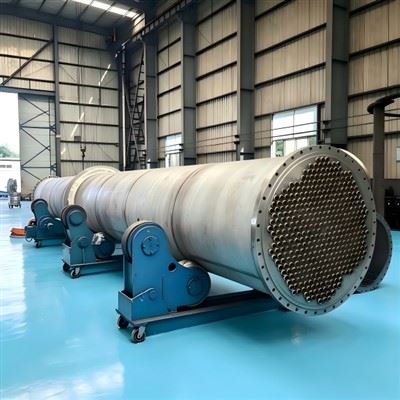

What Type of Industrial Heat Exchanger Do You Require?


GYRO supplies tailored heat exchange equipment matched to your working conditions, process media and heat transfer duties, including the following models:
● Shell and Tube Heat Exchanger
● Fixed Tube Sheet Heat Exchanger
● Floating Head Heat Exchanger
● U-Tube Heat Exchanger
● Reboiler
● Condenser
● Waste Heat Exchanger
● Process Heat Exchanger
If your working conditions involve high temperature, high pressure, corrosive media, fouling-prone materials or frequent start-stop cycles, heat transfer area alone cannot serve as the sole design basis in the preliminary design stage.
Our design calculation comprehensively takes multiple factors into consideration: heat load, medium properties, temperature difference, flow velocity, pressure drop, construction materials, cleaning methods and maintenance clearance.
Key Factors to Check When Purchasing Industrial Heat Exchangers

A Larger Heat Transfer Area Does Not Equal Better Performance
We carry out thermal calculation based on process heat load, inlet & outlet temperatures, flow rates and heat transfer coefficients to figure out a reasonable heat transfer area with optimized design margin. For standard projects, the available heat transfer area ranges from 10 ㎡ to 2,000 ㎡. The final figure is subject to thermal calculation results.

Improper Pressure Drop Control Will Boost Long-Term Operating Costs
GYRO balances heat transfer efficiency and pressure drop throughout the design process. We optimize flow channel structure by adjusting flow rate, pipe diameter, tube pass quantity and flow velocity, minimizing unnecessary energy consumption while meeting heat exchange requirements.

Plan for Cleaning in Advance If Your Media Is Prone to Fouling
Equipment designed for standard working conditions will suffer degraded heat exchange capacity after long-term operation when handling media with solid particles, high viscosity or high fouling tendency.
For such projects, we select suitable pipe diameters, flow velocities and structural forms according to medium properties, while reserving sufficient space for inspection and cleaning.
For equipment requiring frequent maintenance, detachable tube bundles and pull-through structures or mechanical cleaning access can be adopted. Extensive disassembly and modification of on-site pipelines will be avoided during later maintenance.
What Problems Can Industrial Heat Exchangers Solve?
Rapid Heating Requirement
They heat process media via heat transfer oil, steam or other heat carriers to cut heating time during production.
01
Rapid Cooling Requirement
Applied for cooling post-reaction materials, finished products or temperature regulation of process media, preventing outlet temperature fluctuations that disrupt downstream procedures.
02
Heat Recovery for High-Temperature Materials
Waste heat recovery recycles otherwise exhausted heat to preheat raw materials or other process fluids, reducing steam and fuel consumption.
03
Condensation & Recovery Demand
Condense steam, organic solvents or process gases to recover reusable materials and minimize material loss.
04
Stable Temperature Control for Reaction Systems
Matched with reactors, storage tanks and process pipelines to form complete heating or cooling circuits for steady production temperatures.
05
Material Selection Recommendations
- Carbon Steel
- Stainless Steel 304
- Stainless Steel 316L
- Duplex Stainless Steel
- Hastelloy
- Titanium
Material Options
Standard carbon steel is suitable for general, non-corrosive media and helps control equipment costs;
316L is better suited for media containing chlorides or other corrosive elements;
For more severe corrosive conditions, specific alloy materials must be selected based on the medium's composition, concentration, and temperature.
GYRO evaluates material suitability based on the medium composition, concentration, temperature, and pressure you provide, helping to prevent issues such as corrosion, leakage, and premature replacement caused by incorrect material selection.
Technical Specifications
|
Project |
Reference range |
|
Heat Transfer Area |
10–2,000 m² |
|
Design Pressure |
Vacuum to 10.0 MPa |
|
Design Temperature |
-20°C to 450°C |
|
Tube Diameter |
Φ16–Φ38 mm |
|
Tube Length |
1,500–12,000 mm |
|
Tube Material |
CS / SS304 / SS316L / Duplex / Alloy |
|
Shell Material |
Carbon Steel / Stainless Steel |
|
Tube Sheet |
Fixed / Floating / U-Tube |
|
Tube Passes |
1–8 Passes |
|
Connection Size |
DN25–DN800 |
|
Manufacturing Standard |
ASME / GB / HG/T / Customer Specification |
The parameters above serve as reference ranges for typical projects; actual design parameters are determined based on thermal calculations, pressure ratings, fluid properties, and your technical specifications.
FAQ
Q: Heat transfer efficiency drops after several months of operation
A: First identify the root cause among fouling, flow rate fluctuation, medium composition change or inherent equipment defects. We help analyze the issue based on operating parameters and on-site conditions, and provide targeted solutions including cleaning plans, maintenance schedules or process adjustment proposals.
Q: How to handle equipment leakage
A: We locate the leakage point to distinguish failures of tube bundles, tube sheets, flanges or weld seams. If the leakage is verified as a manufacturing defect within the warranty period, we will deliver corresponding solutions in compliance with contract provisions.
Q: Support for post-operation maintenance
A: Sufficient maintenance clearance and pull-through structure access are reserved during equipment design. We also supply regular spare parts such as heat exchange tubes and sealing gaskets for long-term servicing.
Q: Difficulties encountered during on-site installation of equipment
A: For large-scale projects, we provide professional installation guidance and on-site technical service to assist with foundation verification, nozzle orientation adjustment, equipment alignment and pipeline connection requirements.
Q: Can the existing heat exchanger still be used after process parameter changes?
A: Thermal recalculation is mandatory. We will carry out a new thermal performance evaluation based on updated medium properties, flow rates, temperatures and pressures, to confirm whether the original exchanger can keep serving or needs structural modification.
If you have available parameters of the Industrial Heat Exchanger including process medium, flow rate, inlet and outlet temperatures, design pressure, etc., you may send them to us directly.
If you only have general process requirements without confirming the specific heat exchanger model, you can also inform us of your actual working conditions.
ZIBO GYRO offers full support covering equipment type selection, thermal calculation, structural design, fabrication, on-site installation and complete EPC projects.
Hot Tags: industrial heat exchangers, China industrial heat exchangers manufacturers, suppliers, factory, Acid Gas Preheater, Column Bottom Product Heat Exchanger, Industrial Heat Exchangers, Reboiler, Recovery Tower Condenser, Threaded Tube Heat Exchanger