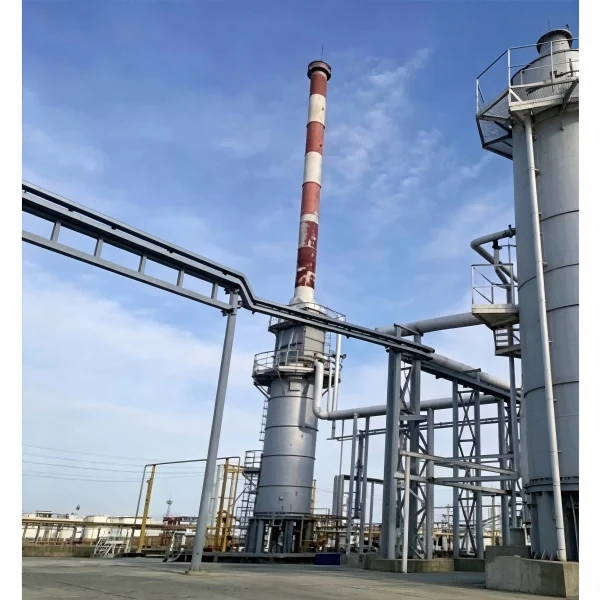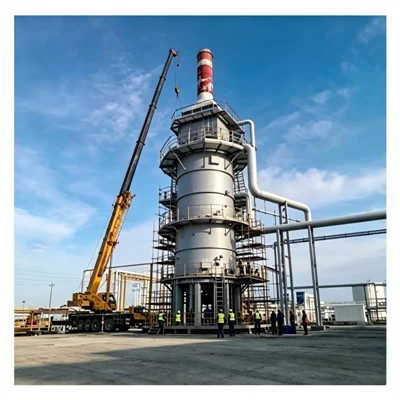

High-efficiency petrochemical furnaces are used for continuous process heating in oil refining, petrochemical, and chemical processing units, specifically addressing issues such as high fuel consumption, low heat utilization efficiency, and localized overheating of furnace tubes.
Advantages of High-Efficiency Petrochemical Furnaces
Heat Balance Analysis Prior to Quotation
GYRO calculates project efficiency based on fuel LHV (Lower Heating Value), heating load, flue gas conditions, furnace heat loss, and waste heat recovery parameters. This ensures that procurement teams, engineering firms, and end-users can compare different quotations based on a consistent set of data.
Focus on Furnace Tube Metal Temperature as a Key Design Metric
GYRO comprehensively controls heat distribution-and verifies furnace tube metal temperatures-by analyzing parameters such as furnace dimensions, burner quantity and placement, tube spacing, and process fluid flow rates. Allowable heat flux limits are not determined by a "one-size-fits-all" numerical standard; instead, they are established based on specific process requirements, materials, and applicable codes.


Furnace Tubes and Flow Paths Designed for Actual Operating Conditions
Furnace tubes are designed according to specific parameters, including diameter, wall thickness, material, number of passes, design pressure, design temperature, and fluid characteristics. If specific tube materials, diameters, or owner standards are already designated, GYRO incorporates these into the design during the technical confirmation phase.
Burner Configuration Tailored to Fuel and Emission Requirements
Burner solutions are determined based on fuel properties (such as fuel gas, natural gas, or fuel oil), heating load, and emission standards. When low-NOx performance is required, the burner system, air supply, and flue gas treatment interfaces are integrated into the design from the project's inception.
Manufacturing Capabilities for Large-Scale, Non-Standard Equipment
GYRO possesses an annual design capacity exceeding 8,000 tons and operates over 150 pieces of processing equipment. Key facilities include six plate-rolling machines (with a maximum capacity of 80mm x 3000mm), two cranes (each with a 100-ton lifting capacity), and an electric heat treatment furnace with effective internal dimensions of approximately 4.5m x 4.5m x 17m.
Comprehensive Support for Overseas Projects: From Technical Inquiry to On-Site Service
We provide a full range of services, including process data confirmation, thermal calculations, mechanical design, manufacturing, non-destructive testing (NDT), factory acceptance testing (FAT), logistics coordination, installation guidance, commissioning, and post-delivery maintenance and retrofitting. For overseas projects, we prepare equipment data sheets, drawings, and quality/inspection documentation early in the process-aligned with the contract scope-to facilitate internal approval workflows for purchasers, EPC contractors, engineering firms, and end-users.

Key Parameters Customizable According to the Project
|
Parameter |
GYRO Design / Supply Scope |
|
Heating Duty |
Calculated according to the process heat load |
|
Process Fluid |
Crude oil, hydrocarbons, process gas and other fluids |
|
Fuel |
Natural gas, fuel gas, fuel oil, etc., subject to project requirements |
|
Furnace Type |
Customized according to process and site conditions |
|
Radiant Section |
Furnace dimensions, tube arrangement, burner layout and heat-flux calculation |
|
Convection Section |
Heat-transfer surface designed according to flue-gas conditions and heat-recovery requirements |
|
Furnace Tubes |
Tube diameter, wall thickness, material, pass arrangement and length based on operating conditions |
|
Design Temperature |
Determined from process conditions and tube-metal-temperature verification |
|
Combustion System |
Selected according to fuel type, heat duty and emission requirements |
|
NDT |
RT, UT, MT and PT according to project specifications and applicable standards |
|
Manufacturing Capacity |
More than 8,000 tons/year design capacity |
|
Workshop Equipment |
More than 150 sets of manufacturing equipment |
|
Maximum Lifting Capacity |
Up to 100 tons per crane, with 2 such cranes |
Key Stages in the Design and Manufacturing of High-Efficiency Petrochemical Furnaces
- Process Parameter Determination – Establishing design conditions based on the process medium, flow rate, inlet/outlet temperatures, operating pressure, fuel type, and heating load.
- Thermal Design – Calculating and optimizing parameters such as the radiant section, convection section, heat load, heat flux, flue gas temperature, and fuel consumption.
- Structural and Mechanical Design – Designing furnace tubes, the furnace body, support structures, headers, and related components based on operating conditions.
- Combustion System Design – Selecting burners based on fuel and heat load, and optimizing burner arrangement and in-furnace temperature distribution.
- Material and Refractory Lining Specification – Selecting appropriate furnace tubes, structural materials, and refractory materials based on operating temperatures, the process medium, and the service environment.
- Manufacturing and Welding – Executing production steps-such as material cutting, rolling, welding, and assembly-in accordance with manufacturing processes.
- Inspection and Testing – Conducting dimensional checks, weld quality inspections, and non-destructive testing (NDT) methods such as RT, UT, MT, and PT, in accordance with project requirements.
- Factory Release and Site Services – Completing final inspections, documentation, and packaging/transport, while providing installation, commissioning, and technical support as required by the project.
After-Sales and Technical Support

Once high-efficiency petrochemical furnaces arrive on-site, factors such as installation orientation, furnace tube connections, burner commissioning, and operating parameters significantly influence final performance.
In accordance with the contract scope, GYRO provides technical guidance on installation, equipment documentation, commissioning support, and analysis of operational issues. We also offer maintenance, retrofitting, and technical consulting services should problems arise later regarding furnace tubes, combustion systems, refractory structures, or other equipment components.
During the preliminary stages, we make every effort to compile comprehensive technical documentation-including equipment drawings, data sheets, and material and inspection records-to minimize the time spent on repeated clarifications between the purchaser, the EPC contractor, and third-party inspection agencies.
Why Choose GYRO High-Efficiency Petrochemical Furnaces?
GYRO does not simply supply standard-model furnaces; instead, we design and manufacture them based on each client's specific process conditions.
Our design process comprehensively considers heating load, fuel consumption, process temperature, heat flux, furnace tube materials, burner performance, refractory systems, maintenance requirements, and site conditions.
Backed by a design team of over 50 professionals, a manufacturing team of 68, and an engineering and technical team of 15, GYRO provides continuous technical support-from initial conceptual design through to equipment delivery-ensuring the furnace is perfectly matched to the overall process unit.
Packaging, Shipment, and Delivery
Large, high-efficiency petrochemical furnaces are delivered as single units, modular assemblies, or in sections, depending on project-specific transportation conditions. During the manufacturing phase, GYRO determines the disassembly or modularization strategy by considering equipment dimensions, weight, transport routes, and on-site lifting conditions.
Before leaving the factory, major components undergo inspection and protective treatment, with a focus on preventing impact, moisture, corrosion, and mechanical damage during transit. For oversized equipment, sectional manufacturing and on-site assembly may be employed to reduce transportation challenges.
Prior to shipment, equipment, accessories, and accompanying documentation are verified against the packing list. Large modules are clearly marked with lifting points, connection locations, and on-site assembly interfaces to facilitate inventory checks and installation upon arrival.
If you are currently comparing suppliers of high-efficiency petrochemical furnaces, please send your existing technical specifications or RFQ directly to us. GYRO can first verify the design conditions and scope of supply, and then provide a tailored technical proposal and quotation.
Hot Tags: high efficiency petrochemical furnaces, China high efficiency petrochemical furnaces manufacturers, suppliers, factory, Fired Heater in Refinery, Fired Heaters For General Refinery Service, Fired Process Heater, Furnace in Petrochemical Industry, Heater in Refinery, High Efficiency Petrochemical Furnaces