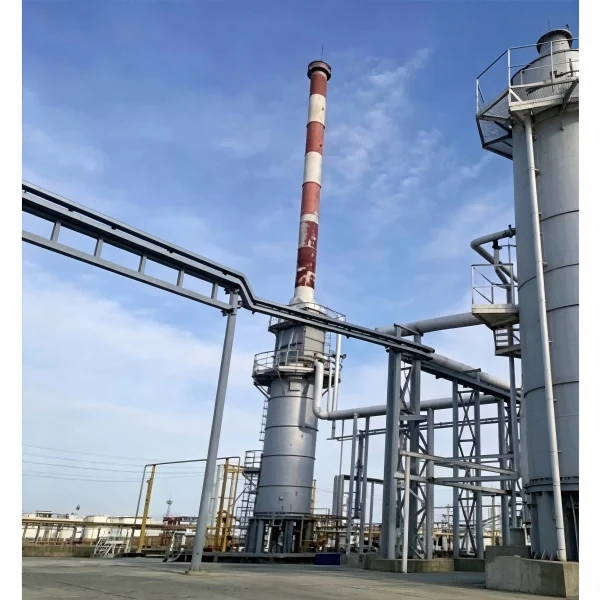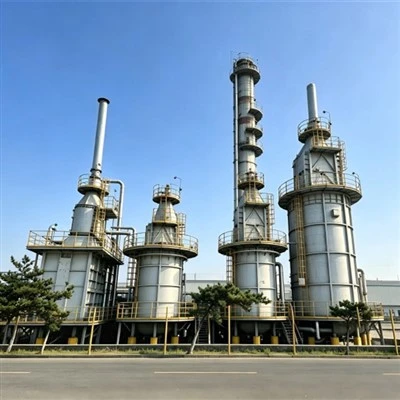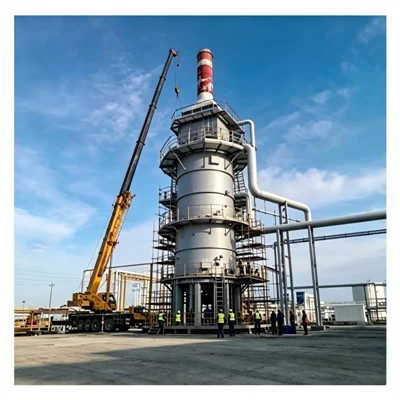

Process heaters are critical equipment in refinery units such as atmospheric and vacuum distillation, hydroprocessing, catalytic reforming, and coking. GYRO custom-designs heaters based on heat load, fluid properties, and operating conditions, and provides equipment manufacturing, installation, and EPC services.
Heater In Refinery Uses
|
Refinery Unit |
Heater Application |
Main Purpose |
|
Crude Distillation Unit (CDU) |
Crude Oil Heater |
Heat crude oil before atmospheric distillation |
|
Vacuum Distillation Unit (VDU) |
Vacuum Heater |
Heat reduced crude under vacuum conditions |
|
Hydrotreating Unit |
Feed Heater |
Heat hydrocarbon feed before reaction |
|
Hydrocracking Unit |
Charge Heater |
Heat feed to required reactor inlet temperature |
|
Catalytic Reforming |
Charge Heater |
Heat feed before catalytic reaction |
|
Delayed Coking Unit |
Coker Heater |
Heat heavy feed before entering coke drums |
|
Stabilizer Unit |
Reboiler / Process Heater |
Provide heat for separation and stabilization |
|
Sulfur Recovery Unit |
Process Heater |
Provide controlled heat for sulfur recovery processes |
Refinery Heater Parameters
|
Parameter |
Typical Range |
|
Heater Type |
Vertical Cylindrical / Cabin / Box / Multi-Cell |
|
Firing Type |
Natural Draft / Forced Draft / Balanced Draft |
|
Process Duty |
5–150 MW |
|
Design Pressure |
Vacuum to 15 MPa |
|
Design Temperature |
Up to 600°C |
|
Process Outlet Temperature |
150–500°C |
|
Radiant Section |
Radiant Coil + Burners |
|
Convection Section |
Convection Coil / Steam Coil / Air Preheater |
|
Tube Material |
Carbon Steel / Cr-Mo Steel / SS304 / SS316 / SS321 / Nickel Alloy |
|
Refractory Material |
Ceramic Fiber / Castable / High-Alumina Refractory |
|
Fuel |
Natural Gas / Refinery Fuel Gas / Fuel Oil / Dual Fuel |
|
Burner Type |
Low-NOx / Conventional / Dual-Fuel Burner |
|
Control System |
PLC / DCS / SIS Integration |
|
Design Standard |
API 560 / API 530 / ASME / Customer Specification |
How Do You Choose Between Different Heater Designs For A Refinery
|
Heater Configuration |
Best Fit |
Main Advantage |
Main Consideration |
|
Vertical Cylindrical |
Small to Medium Duty |
Compact footprint |
Limited radiant capacity |
|
Cabin Heater |
Medium to Large Duty |
Large heating surface |
Larger footprint |
|
Box Heater |
Large Process Duty |
Flexible coil arrangement |
Higher fabrication complexity |
|
Multi-Cell Heater |
High Duty / Critical Service |
Better heat distribution |
Higher initial investment |
The specific furnace type is determined based on factors such as heat load, plant site space, properties of the process medium, combustion method, and future capacity expansion requirements. Common API 560 furnace types include vertical cylindrical, cabin, and box heaters; the choice of furnace type is closely linked to heat load, the process medium, and site constraints.
Example of Option Comparison
|
Item |
Basic Configuration |
Optimized Configuration |
|
Process Duty |
20 MW |
20 MW |
|
Combustion Air Preheating |
No |
Yes |
|
Waste Heat Recovery |
Limited |
Integrated |
|
Flue Gas Heat Utilization |
Low |
Higher |
|
Fuel Consumption |
Higher |
Lower |
|
Operating Cost |
Higher |
Reduced |
|
Initial Investment |
Lower |
Higher |
|
Long-Term Economic Value |
Moderate |
Higher |
Manufacturing Process for Refinery Heaters
Heater Body
Following the cutting, assembly, and welding of the steel structure, dimensional inspections are conducted to ensure the structure meets design specifications.
Heater Tubes
Tube bending, assembly, welding, and non-destructive testing are performed in accordance with design drawings.
Tube Supports
Installation positioning and thermal expansion clearances are strictly controlled to prevent abnormal stresses during high-temperature operation.


Refractory Lining
Materials such as ceramic fiber and refractory castables are selected based on furnace operating temperatures; installation thickness and the furnace dry-out procedure are strictly controlled.
Burners
Following installation, checks are performed on positioning, orientation, and flame coverage to ensure the flame does not directly impinge upon the heater tubes.
What are GYRO's capabilities?
GYRO provides services tailored to project requirements, including:
Process Design→Thermal Calculation→Mechanical Design→Heater Fabrication→Burner / Control System Integration→Factory Inspection→Site Installation→Commissioning Support→EPC Project Execution
For comprehensive refinery projects, GYRO also offers integrated design and manufacturing services for associated equipment such as towers, heat exchangers, reactors, and pressure vessels.


Quality Control and Project Documentation
In accordance with project requirements, we can provide the following:
- Material Certificates
- Welding Procedure Specifications
- Welder Qualification Records
- NDT Reports
- Hydrostatic / Pressure Test Records
- Dimensional Inspection Reports
- Refractory Inspection Records
- Burner Inspection Records
- Factory Acceptance Test Documentation
- As-Built Drawings
- Operation & Maintenance Documentation
We also accommodate third-party inspections and on-site client acceptance.
If you are sourcing a refinery heater, we do not recommend comparing prices based solely on the required thermal duty (MW rating).
Please provide us with the following information:
Process fluid, flow rate, inlet/outlet temperatures, operating pressure, required duty, and fuel type.
Based on these details, ZIBO GYRO can evaluate the heater type, tubes, burners, radiant and convection sections, and waste heat recovery options. We can then provide solutions ranging from individual equipment units to complete packages or full EPC (Engineering, Procurement, and Construction) services, tailored to the project scale.
Finalizing the thermal design before discussing equipment pricing is far more cost-effective than purchasing a heater that has a low initial price but high operating costs.
Hot Tags: heater in refinery, China heater in refinery manufacturers, suppliers, factory, Crude Heater, Fired Heater in Refinery, Fired Heaters For General Refinery Service, Fired Process Heater, Furnace in Petrochemical Industry, Heater in Refinery